Water vapor
📥 Download PDFWater vapor is the gaseous state of water. It is colorless, tasteless, and odorless. When in its pure form or as a component of a humid gas in thermodynamic equilibrium with a condensed phase (liquid or ice), it is referred to as saturated water vapor. Water vapor is primarily concentrated within the troposphere.
Water vapor is formed from water molecules during evaporation, boiling, or sublimation from ice. It has a lower density than most other components of air, which causes convective currents. These air currents, in turn, can lead to the formation of clouds. When water vapor is added to air, it creates a certain pressure, similar to other gases, known as partial pressure. This pressure is measured in pascals. Water vapor can pass directly into a solid phase, forming ice crystals (desublimation). The amount of water vapor in one cubic meter of air, measured in grams, is called the absolute humidity of the air.
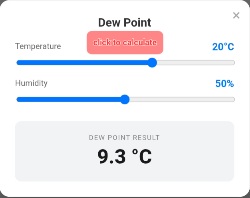
Water (vapor) dew point calculator
Historical Overview
The scientific understanding of water vapor has developed over several centuries alongside advances in physics, chemistry, and atmospheric science. Early observations recognized water vapor as the invisible form of water responsible for clouds and precipitation, but its physical properties were quantified much later.
In 1643, Evangelista Torricelli’s invention of the mercury barometer laid the foundation for studying atmospheric pressure, a key factor in understanding evaporation and vapor behavior. Later, in 1661, Robert Boyle formulated Boyle’s law, describing the inverse relationship between gas pressure and volume, which applies to water vapor as a gas.
A major breakthrough occurred in the late 18th century with the work of James Watt and Joseph Black. Black introduced the concept of latent heat in the 1760s, quantifying the large amount of energy required for phase changes between liquid water and vapor. This concept was essential for understanding evaporation, condensation, and the role of water vapor in heat transfer.
In the 19th century, precise measurements of water vapor pressure became possible. In 1834, Émile Clapeyron developed the thermodynamic relationship later refined into the Clausius–Clapeyron equation, which quantitatively describes how saturation vapor pressure increases with temperature. This relationship remains fundamental in modern meteorology and climate science.
The role of water vapor in Earth’s energy balance was first identified in the early 1800s. In 1824, Joseph Fourier proposed that Earth’s atmosphere traps heat, and in 1859, John Tyndall experimentally demonstrated that water vapor strongly absorbs infrared radiation. His measurements showed that even trace amounts of water vapor have a significant warming effect compared to major atmospheric gases such as nitrogen and oxygen.
By the 20th century, routine atmospheric measurements revealed that water vapor is highly variable, ranging from less than 0.1% by volume in cold, dry air to about 4% in warm, humid conditions. With the advent of weather balloons in the 1930s and satellites in the 1960s, global observations confirmed that most water vapor is confined to the troposphere and that the global mean precipitable water vapor is approximately 25 mm.
Today, water vapor is recognized as the dominant natural greenhouse gas, responsible for approximately 50–60% of the natural greenhouse effect, and as a key feedback mechanism in climate change. Its historical study has been central to the development of thermodynamics, meteorology, and modern climate science.
Water Vapor Properties
Water vapor is the gaseous phase of water (H₂O) and is a naturally occurring component of Earth’s atmosphere. Its physical and thermodynamic properties play a critical role in weather, climate, and heat transfer processes.
Water vapor has a molar mass of 18.01528 g/mol, which is lower than that of dry air (approximately 28.97 g/mol). Because of this difference, moist air is less dense than dry air at the same temperature and pressure. At standard atmospheric pressure (101.325 kPa), pure water boils at 100 °C (373.15 K), but water vapor can exist at much lower temperatures due to evaporation.
The saturation vapor pressure of water vapor strongly depends on temperature. For example:
- At 0 °C, the saturation vapor pressure is approximately 0.611 kPa.
- At 20 °C, it increases to about 2.34 kPa.
- At 100 °C, it equals atmospheric pressure at 101.325 kPa.
Water vapor has a high latent heat of vaporization, equal to approximately 2257 kJ/kg at 100 °C (about 2500 kJ/kg at 0 °C). This means a large amount of energy is required to convert liquid water into vapor without changing temperature, making water vapor a major carrier of energy in the atmosphere.
In terms of thermal properties, the specific heat capacity of water vapor at constant pressure is about 1.86 kJ/(kg·K), which is higher than that of dry air (~1.005 kJ/(kg·K)). This contributes to the ability of humid air to store and transport more heat.
The concentration of water vapor in air is commonly expressed as absolute humidity, specific humidity, or relative humidity. Under typical atmospheric conditions, water vapor constitutes between 0% and about 4% by volume of air, depending on temperature and location.
These properties make water vapor a key factor in atmospheric thermodynamics, cloud formation, precipitation processes (water cycle), and the greenhouse effect.
| Greenhouse Gas | Approximate Contribution |
|---|---|
| Water vapor | 50–60% |
| Clouds | ~25% |
| Carbon dioxide | ~20% |
Water Vapor in Earth’s Atmosphere
Water vapor is a variable but essential component of Earth’s atmosphere, influencing weather systems, climate regulation, and the global energy balance. Unlike major atmospheric gases such as nitrogen and oxygen, its concentration changes rapidly in space and time due to evaporation, condensation, and precipitation processes.
On a global average, water vapor makes up about 0.25% of the total atmospheric mass. By volume, its concentration typically ranges from nearly 0% in cold polar regions and the upper troposphere to about 3–4% in warm, tropical near-surface air. The maximum possible amount of water vapor in air increases exponentially with temperature, as described by the Clausius–Clapeyron relation (approximately 7% increase in saturation vapor pressure per 1 °C of warming).
Most atmospheric water vapor is concentrated in the troposphere, the lowest layer of the atmosphere extending up to about 8 km at the poles and 16–18 km in the tropics. Above this level, temperatures are too low to support significant amounts of water vapor. In the stratosphere, typical mixing ratios are very small, around 3–6 parts per million by volume (ppmv).
Water vapor is the most abundant greenhouse gas in Earth’s atmosphere. It accounts for roughly 50–60% of the natural greenhouse effect, primarily by absorbing infrared radiation in multiple wavelength bands. Unlike carbon dioxide, water vapor acts mainly as a climate feedback rather than a direct forcing, because its atmospheric concentration is controlled by temperature.
The global mean precipitable water vapor (the total depth of water that would result if all atmospheric vapor condensed) is approximately 25 mm. However, this value varies significantly, from less than 5 mm in cold regions to more than 50 mm in humid tropical areas.
Through evaporation and condensation, water vapor transports large amounts of latent heat. The global mean release of latent heat through precipitation is on the order of 80 W/m², making water vapor a dominant driver of atmospheric circulation and storm development.
Water Vapor Facts
- Chemical composition: Water vapor is the gaseous form of water with the chemical formula H₂O and a molar mass of 18.015 g/mol.
- Density effect: Because water vapor is lighter than dry air (average molar mass 28.97 g/mol), humid air is less dense than dry air at the same temperature and pressure.
- Atmospheric concentration: Water vapor typically составляет from 0% by volume in cold, dry conditions to about 3–4% in warm, humid near-surface air.
- Global average content: The mean global amount of atmospheric water vapor corresponds to a precipitable water depth of ~25 mm.
- Vertical distribution: About 99% of atmospheric water vapor is located in the troposphere, mostly below 10–12 km altitude.
- Phase change energy: The latent heat of vaporization of water is approximately 2257 kJ/kg at 100 °C and about 2500 kJ/kg at 0 °C.
- Heat capacity: The specific heat capacity of water vapor at constant pressure is around 1.86 kJ/(kg·K), higher than that of dry air (~1.005 kJ/(kg·K)).
- Greenhouse role: Water vapor is the most abundant greenhouse gas, contributing roughly 50–60% of the natural greenhouse effect.
- Temperature dependence: The saturation vapor pressure of water increases by about 7% for every 1 °C rise in air temperature.
- Stratospheric levels: In the stratosphere, typical water vapor concentrations are very low, around 3–6 parts per million by volume (ppmv).
Heat carrier
Due to the relatively high heat capacity of steam, more precisely its latent heat of condensation, it is widely used as an efficient heat carrier. Examples include steam heating systems, evaporative air cooling, and steam generators. Evaporative cooling is used in air conditioning systems.
In addition, taking into account the very high heat capacity of the phase change process, water at saturation temperature is used to cool high-power electric lamp anodes and internal combustion engines.
Thermodynamics of Water Vapor
From a thermodynamic perspective, water vapor plays a key role because of its high phase-change energy. The latent heat of vaporization is about 2500 kJ/kg at 0 °C and decreases slightly with temperature, reaching around 2257 kJ/kg at 100 °C.
The behavior of water vapor in equilibrium with liquid water is described by the Clausius–Clapeyron equation, first formulated by Émile Clapeyron in 1834 and later refined by Rudolf Clausius. This equation explains why warm air can store far more moisture than cold air.
Water Vapor in the Hydrological Cycle
Water vapor is the atmospheric link between oceans, land, and precipitation. Each year, approximately 505,000 km³ of water evaporates from Earth’s surface, with about 86% coming from oceans and 14% from land.
After entering the atmosphere, water vapor is transported by winds and eventually condenses to form clouds and precipitation. The average amount of water vapor stored in the atmosphere at any time is equivalent to only about 25 mm of liquid water, meaning the entire atmospheric reservoir is recycled many times per year.
| Process | Approximate Value |
|---|---|
| Annual global evaporation | ~505,000 km³/year |
| Atmospheric residence time | ~9–10 days |
Weather Processes
Water vapor strongly controls day-to-day weather. When moist air rises and cools, condensation releases latent heat, which fuels clouds, storms, and large-scale circulation. This process is essential for the development of thunderstorms, tropical cyclones, and frontal systems.
For example, the release of latent heat during condensation provides a major energy source for hurricanes, where surface air can contain more than 20 g/m³ of water vapor. In dry air, the same storm systems weaken rapidly due to the lack of available moisture.
Climate Feedbacks
Water vapor is a classic example of a positive climate feedback. When global temperature rises, evaporation increases, leading to higher atmospheric moisture content. This additional water vapor enhances infrared absorption, amplifying the initial warming.
According to the Clausius–Clapeyron relationship, the atmosphere can hold about 7% more water vapor per 1 °C of warming. Climate models consistently show that this feedback roughly doubles the warming caused by carbon dioxide alone. However, water vapor itself does not accumulate independently, as it has an average atmospheric residence time of only about 9–10 days.
Water Vapor vs. Carbon Dioxide
Water vapor and carbon dioxide differ significantly in their atmospheric roles. Water vapor concentrations range from near 0% to about 4% by volume, while carbon dioxide is well mixed at roughly 420 ppm (0.042%).
Carbon dioxide has a long atmospheric lifetime of decades to centuries, allowing it to directly drive climate change. Water vapor, in contrast, responds quickly to temperature changes and acts mainly as a feedback rather than a forcing.
| Property | Water Vapor | Carbon Dioxide |
|---|---|---|
| Typical concentration | 0–4% | ~420 ppm |
| Atmospheric lifetime | ~10 days | Decades–centuries |
Water Vapor in the Upper Atmosphere
Most water vapor is confined to the troposphere, but small amounts enter the stratosphere through the tropical tropopause. At these altitudes, typical mixing ratios are only about 3–6 ppmv.
Despite its low concentration, stratospheric water vapor influences ozone chemistry and radiative balance. Increases of just 1 ppmv in the lower stratosphere can produce measurable changes in surface temperature over long timescales.
Human Influence on Atmospheric Water Vapor
Humans affect atmospheric water vapor mainly indirectly. Rising temperatures caused by greenhouse gas emissions increase evaporation from oceans, lakes, and soils, leading to higher humidity.
Direct emissions of water vapor from human activities—such as combustion, irrigation, and aviation—are small compared to natural fluxes. For example, global irrigation increases regional humidity, but its impact is minor compared to the large-scale effect of warming-driven moisture increase. Aviation can inject water vapor into the upper troposphere and lower stratosphere, contributing to contrail and cirrus cloud formation, which has a measurable but still uncertain climate effect.
Question and Answer
- Q: What is water vapor?
A: Water vapor is the gaseous form of water (H₂O). It is colorless, odorless, and tasteless. Unlike liquid water or ice, it exists as a gas and can freely mix with air in the atmosphere. - Q: How is water vapor formed?
A: Water vapor forms through evaporation from oceans, lakes, and rivers, boiling of water, or sublimation from ice. The process depends on temperature, pressure, and humidity levels. - Q: Why is water vapor important for weather?
A: Water vapor drives cloud formation, precipitation, and storms. When moist air rises and cools, it condenses into clouds, releasing latent heat that powers atmospheric circulation. - Q: What role does water vapor play in the greenhouse effect?
A: Water vapor is the most abundant greenhouse gas, contributing roughly 50–60% of the natural greenhouse effect. It absorbs infrared radiation and traps heat in the lower atmosphere, regulating Earth’s temperature. - Q: How does water vapor differ from carbon dioxide?
A: Water vapor acts mainly as a feedback controlled by temperature and has a short atmospheric lifetime of about 9–10 days. Carbon dioxide, in contrast, is a direct forcing gas with a concentration of ~420 ppm and a lifetime of decades to centuries. - Q: Can humans directly increase atmospheric water vapor?
A: Direct emissions from human activities, such as combustion, irrigation, and aviation, are small compared to natural fluxes. However, humans indirectly increase water vapor by warming the climate, which enhances evaporation. - Q: How much water vapor is in the atmosphere?
A: Globally, water vapor constitutes about 0–4% by volume in air, with a global mean precipitable water of roughly 25 mm. Concentrations are higher in warm tropical regions and lower in cold polar areas and the upper troposphere. - Q: What is absolute humidity?
A: Absolute humidity measures the mass of water vapor in one cubic meter of air, typically expressed in grams per cubic meter (g/m³). It quantifies the actual amount of moisture present in the air.