Ocean: what is it, information
📥 Download PDFThe Ocean (Ancient Greek: Ὠκεανός, from the name of the ancient Greek god Oceanus) is a large body of water located between continents, forming part of the World Ocean, featuring a system of water circulation and other characteristic features. The ocean is in constant interaction with the atmosphere and the Earth's surface.
Simply put, an ocean is a large body of salt water that covers most of the Earth's surface.
Ocean
The surface area of the World Ocean, which includes oceans and seas, is approximately 139 million square miles (about 361 million square kilometers), covering 71% of the Earth's surface. The topography of the ocean floor is generally complex and diverse.
The term ocean is also used for other planets and their moons, such as the subsurface ocean on Jupiter’s moon Europa.
The science that studies the oceans is called oceanography; the study of marine fauna and flora is a branch of biology called marine biology.
There are five oceans on Earth:
- The Pacific Ocean is the largest and deepest.
- The Atlantic Ocean is between the Americas, Europe, and Africa.
- The Indian Ocean is between Africa, Asia, and Australia.
- The Arctic Ocean is around the North Pole and is the coldest and the smallest.
- The Southern (Antarctic) Ocean is around Antarctica, officially recognized by the International Hydrographic Organization in 2000.
Ancient meaning
In ancient Rome, the word Oceanus referred to the waters surrounding the western world, mainly referring to the open Atlantic Ocean. Similarly, the phrase Oceanus Germanicus («Germanic Ocean») or Oceanus Septentrionalis («Northern Ocean») referred to the North Sea, while Oceanus Britannicus («British Ocean») referred to the English Channel.
Modern definition of oceans
The World Ocean is the global volume of water, which covers about 94.1% of the total area of the hydrosphere. It is a single, continuous body of water on Earth, divided by continents and islands, and characterized by a common salinity. Continents and large archipelagos divide the World Ocean into parts (oceans). Large areas of the ocean are known by the names seas, gulfs, straits, and other similar features.
Some sources divide the World Ocean into four parts, while others divide it into five. Five oceans were designated between 1937 and 1953: the Pacific, Atlantic, Indian, Arctic, and Southern (or Antarctic) oceans. The term «Southern Ocean» was often used in the 18th century, when systematic studies of the region began. According to publications of the International Hydrographic Organization, the Southern Ocean was designated in 1937, consisting of the Atlantic, Indian and Pacific oceans. Their justification was that the ocean has three oceans on its southern border, while the waters adjacent to Antarctica have a specific character and are also connected by the Antarctic Circumpolar Current. However, as a result, they refused to designate a separate Southern Ocean. In 2000, the International Hydrographic Organization decided to divide it into five oceans, but this decision has not been ratified to this day (2022), so legally there are only 4 oceans.
| Ocean | Area, million km² | Volume, million km³ | Average depth, m | Deepest place, m | Seas |
|---|---|---|---|---|---|
| Atlantic | 91.6 | 329.7 | 3600 | 8742 (Puerto Rico Trench) | Baltic, Northern, Mediterranean, Black, Sargasso, Caribbean, Adriatic, Azov, Balearic, Ionian, Irish, Marble, Tyrrhenian, Aegean; Bay of Biscay, Gulf of Guinea, Gulf of Mexico |
| Indian | 73,556 | 292.1 | 3890 | 7725 (Trough) | Andaman, Arabia, Red, Laccadive, Timor; Bay of Bengal, Great Australian Bight, Persian Gulf |
| Arctic | 14.75 | 18.1 | 1225 | 5527 (in the Greenland Sea) | Norway, Barents, White, Kara, Laptev, East Siberian, Chukotka, Greenland, Beaufort, Baffin, Lincoln; Hudson Bay |
| Pacific | 169.2 | 710 | 4280 | 11,022 (Marian Trench) | Bering, Okhotsk, Japan, East China, Yellow, South China, Javan, Sulawesi, Sulu, Philippine, Arafura, Coral, Fiji, Tasman |
| Southern | 20,327 | 72.37 | 3270 | 8264 (South Sandwich Trench) | Lazarev Sea, Reeser-Larsen, Cosmonauts, Commonwealth, Davis, Mawson, Durville, Somov, Ross, Amundsen, Bellingshausen, Scotia, Weddell |
Brief description of the oceans
Pacific Ocean (or Great) — the largest ocean on Earth in terms of area and depth. It is located in the west between the continents of Eurasia and Australia, in the east between North and South America, and in the south above Antarctica. In the north, it is connected to the waters of the Arctic Ocean through the Bering Strait, and in the south - with the waters of the Atlantic and Indian Oceans. Occupying 49.5% of the surface area of the World Ocean and 53% of its water volume, the Pacific Ocean extends approximately 15.8 thousand km from north to south and 19.5 thousand km from east to west. The date line passes through the Pacific Ocean, roughly following the 180th meridian. The study and development of the Pacific Ocean began even before the emergence of recorded human history. Junks (traditional Chinese sailing ships), catamarans, and simple boats were used to sail the ocean. The 1947 expedition in the balsa-hulled Kon-Tiki, led by Norwegian Thor Heyerdahl, established that it was possible to sail (cross) the Pacific Ocean from central South America to the Polynesian islands in a westerly direction. Chinese junks (a type of ship) sailed along the ocean's coasts and into the Indian Ocean (for example, Zheng He's seven voyages from 1405 to 1433). Currently (2022), the coasts and islands of the Pacific Ocean are very unevenly developed and populated. The largest centers of industrial development are the coasts of the United States (from the Los Angeles area to the San Francisco area), Japan, and South Korea. The ocean also plays an important role in the economic life of Australia and New Zealand.
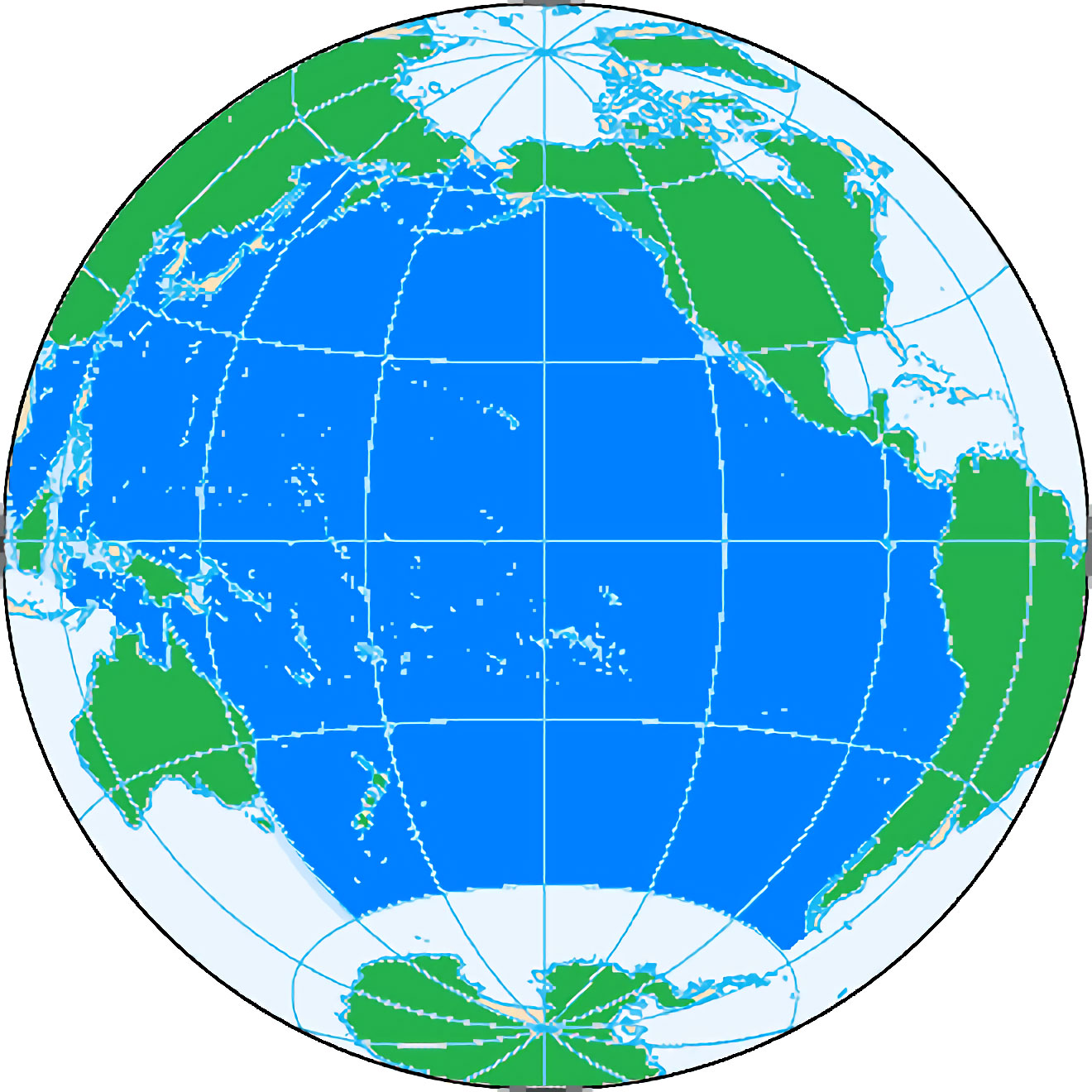
Pacific Ocean
The Atlantic Ocean is the second largest ocean on Earth, named after the Greek mythological titan Atlas or the legendary island of Atlantis. It extends from the subarctic latitudes to Antarctica. The border with the Indian Ocean runs along the meridian of Cape Agulhas (at 20° East longitude to the coast of Antarctica, specifically Queen Maud Land). The border with the Pacific Ocean runs either from Cape Horn to the 68°04′ West meridian or from Tierra del Fuego to the Antarctic Peninsula, through the Drake Passage. The border with the Arctic Ocean runs through various straits and points, including the eastern entrance of Hudson Strait, Davis Strait, the coast of Greenland, the Denmark Strait (between Iceland and Greenland), and south of the Faroe and Shetland Islands to the Scandinavian Peninsula at 61° North latitude. The total area of the Atlantic is 91.6 million km², with about a quarter being inland continental seas. However, the area of the coastal seas is small, not exceeding 1% of the total ocean surface area. Its volume is 329.7 million km³, which is equal to approximately 25% of the volume of the World Ocean. The average depth is 3736 m, the deepest point is 8742 m (Puerto Rico Trench). The average annual salinity of the ocean is approximately 35 ‰. The Atlantic Ocean has a rugged coastline with water areas divided into distinct features: seas and bays.
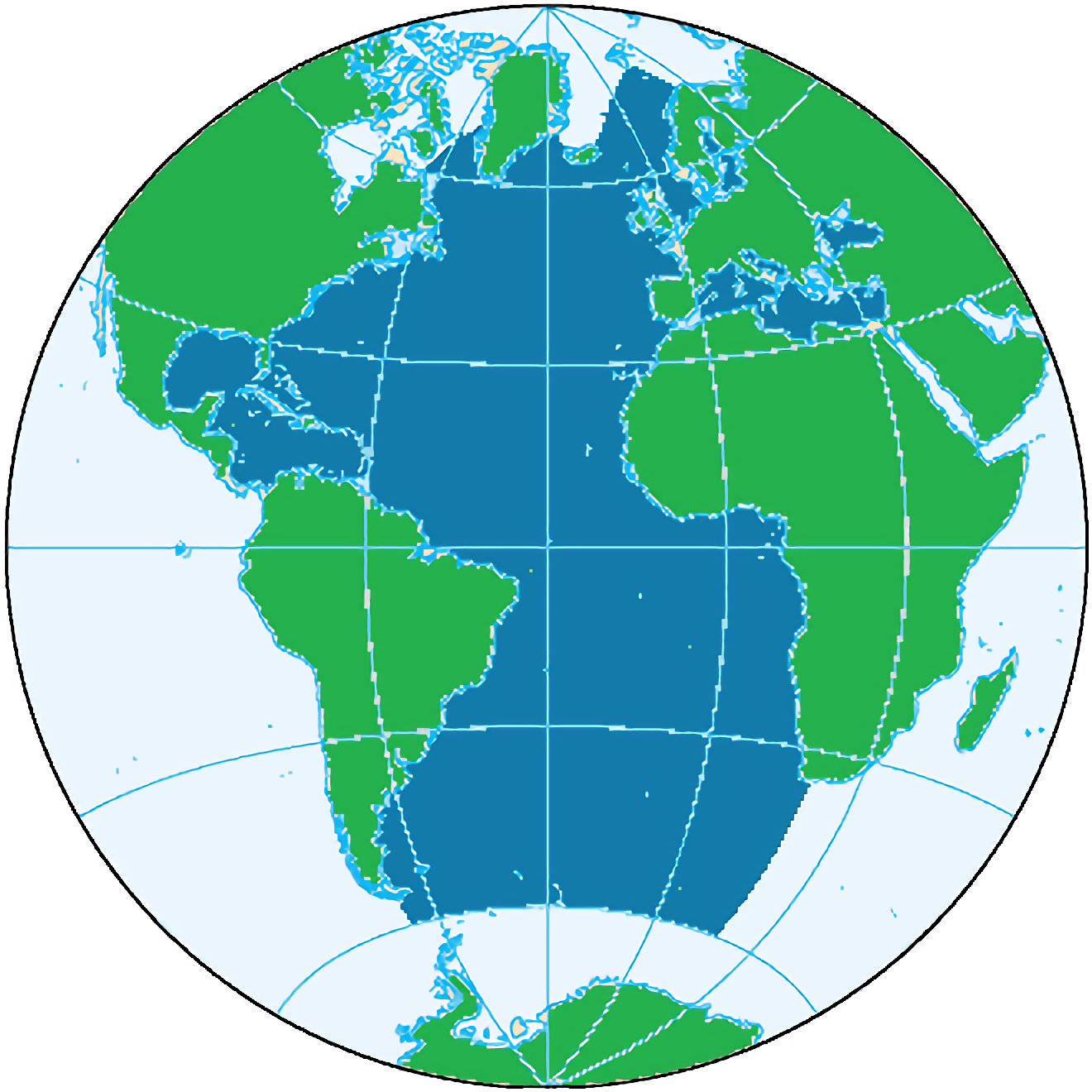
Atlantic Ocean
Indian Ocean — The third largest ocean on Earth and covering about 20% of the water surface. The Indian Ocean (sometimes spelled Ind Ocean) is located mainly south of the Tropic of Cancer, and is surrounded by Eurasia to the north, Africa to the west, Australia to the east, and Antarctica to the south. Its area is 76.17 million km², and its volume is 282.65 million km³. It is bounded by Asia to the north, the Arabian Peninsula and Africa to the west, and Indochina, the Sunda Islands, and Australia to the east; it borders the Southern Ocean to the south. The border with the Atlantic Ocean runs along the meridian of 20° east longitude; with the Pacific Ocean, along the meridian of 147° east longitude. The northernmost point of the Indian Ocean is located in the Persian Gulf at approximately 30° north latitude. The approximate width of the Indian Ocean at the southernmost points of Australia and Africa is about 10,000 km.
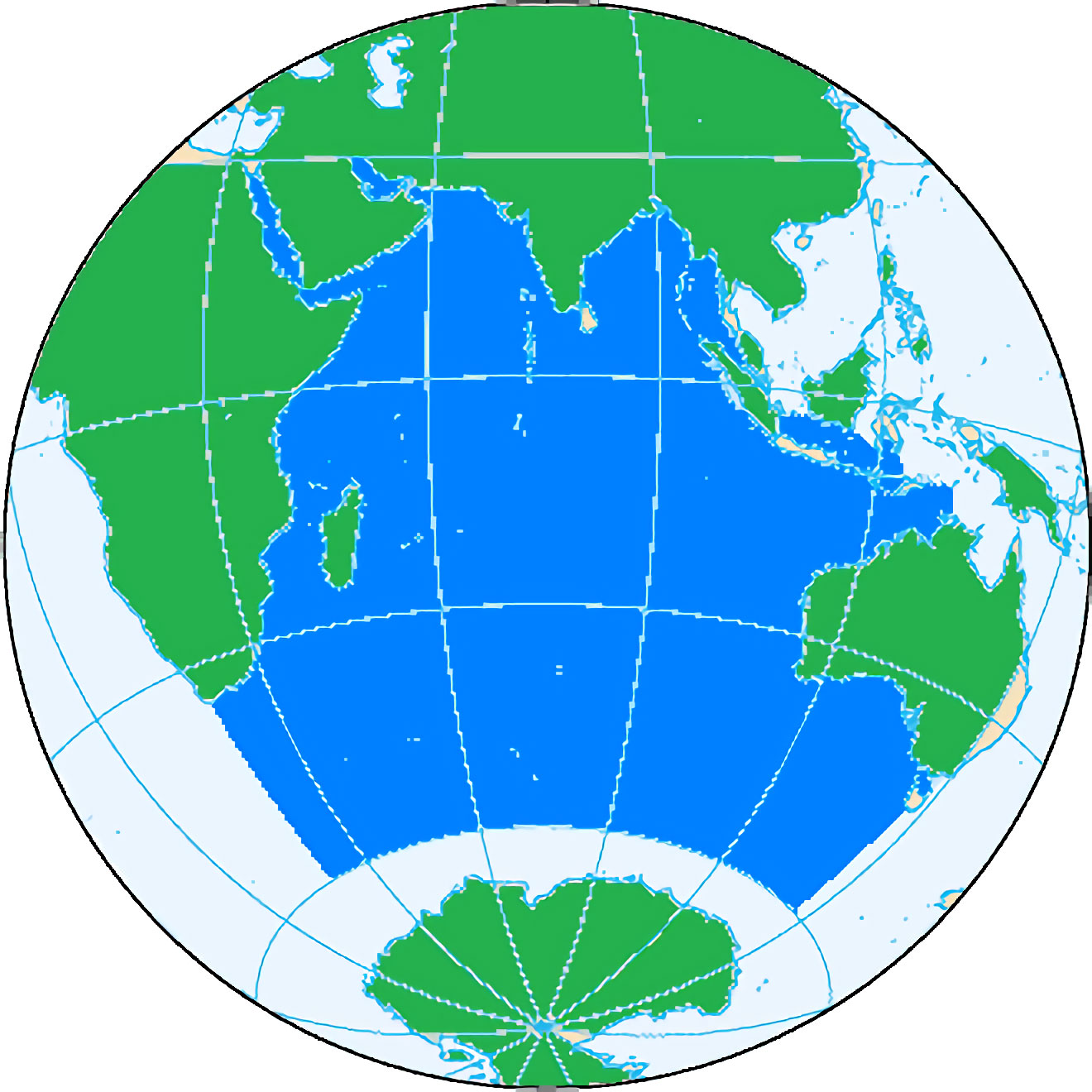
Indian Ocean
The Arctic Ocean is the smallest ocean on Earth, located between Eurasia and North America. Its area is 14.75 million km², or slightly more than 4% of the entire area of the World Ocean, and its water volume is 18.07 million km³. The Arctic Ocean is the shallowest of all oceans, with an average depth of 1225 m (the deepest point is 5527 m, in the Eurasian Basin).
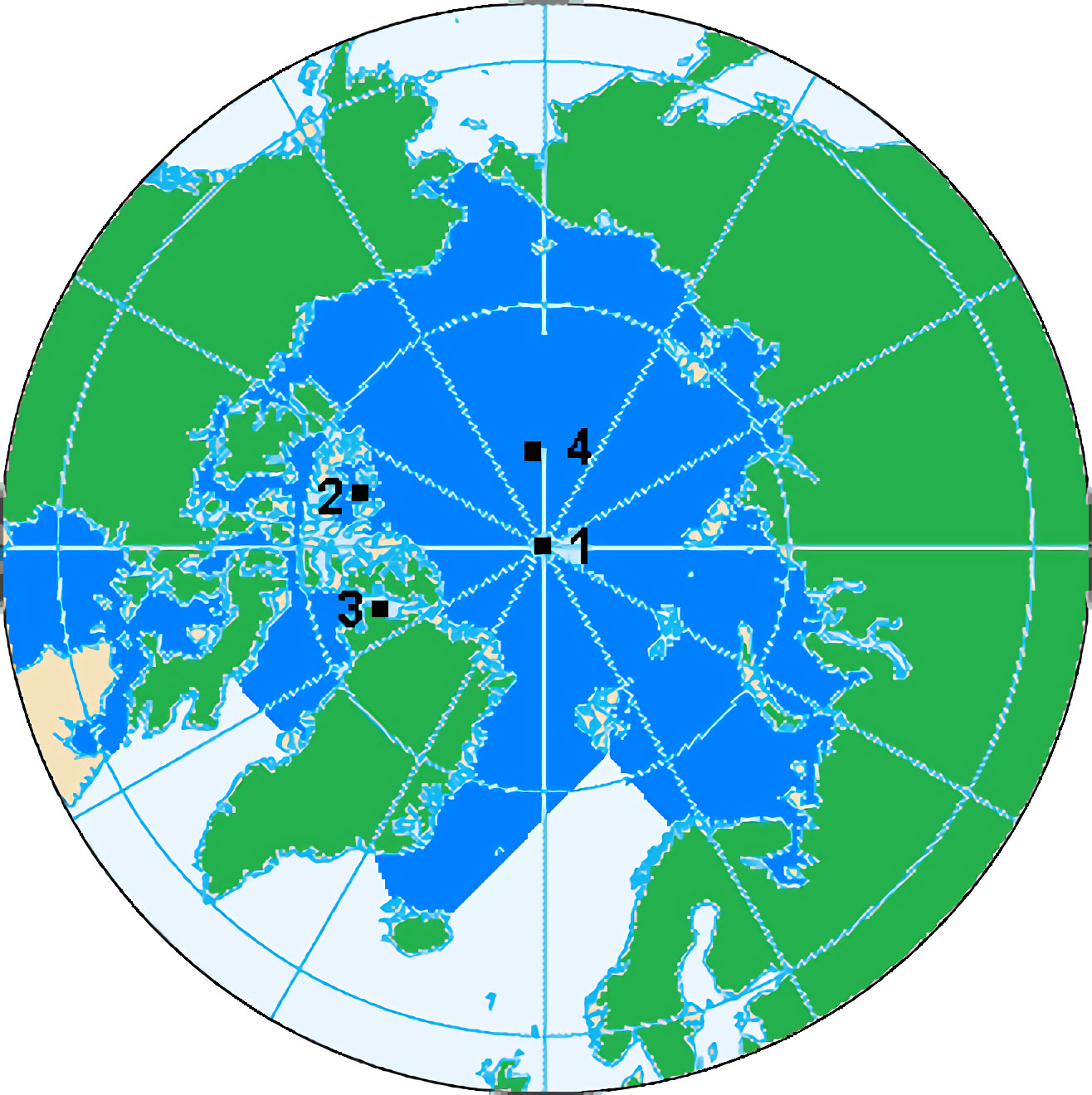
Arctic Ocean: 1 — North Pole; 2 — North Magnetic Pole; 3 — North Geomagnetic Pole; 4 — North Pole of Inaccessibility
The Southern Ocean is the southernmost ocean on Earth. It surrounds Antarctica (not to be confused with the Arctic), has an area of 20.327 million km², an average depth of 3270 m, and a water volume of 72.37 million km³. The deepest point is the South Sandwich Trench, at 8264 m. The Southern Ocean is bordered by the Indian Ocean in the north, the Pacific Ocean in the southeast, and the Atlantic Ocean in the northwest. It is the coldest ocean, with an average temperature of -12 °C.
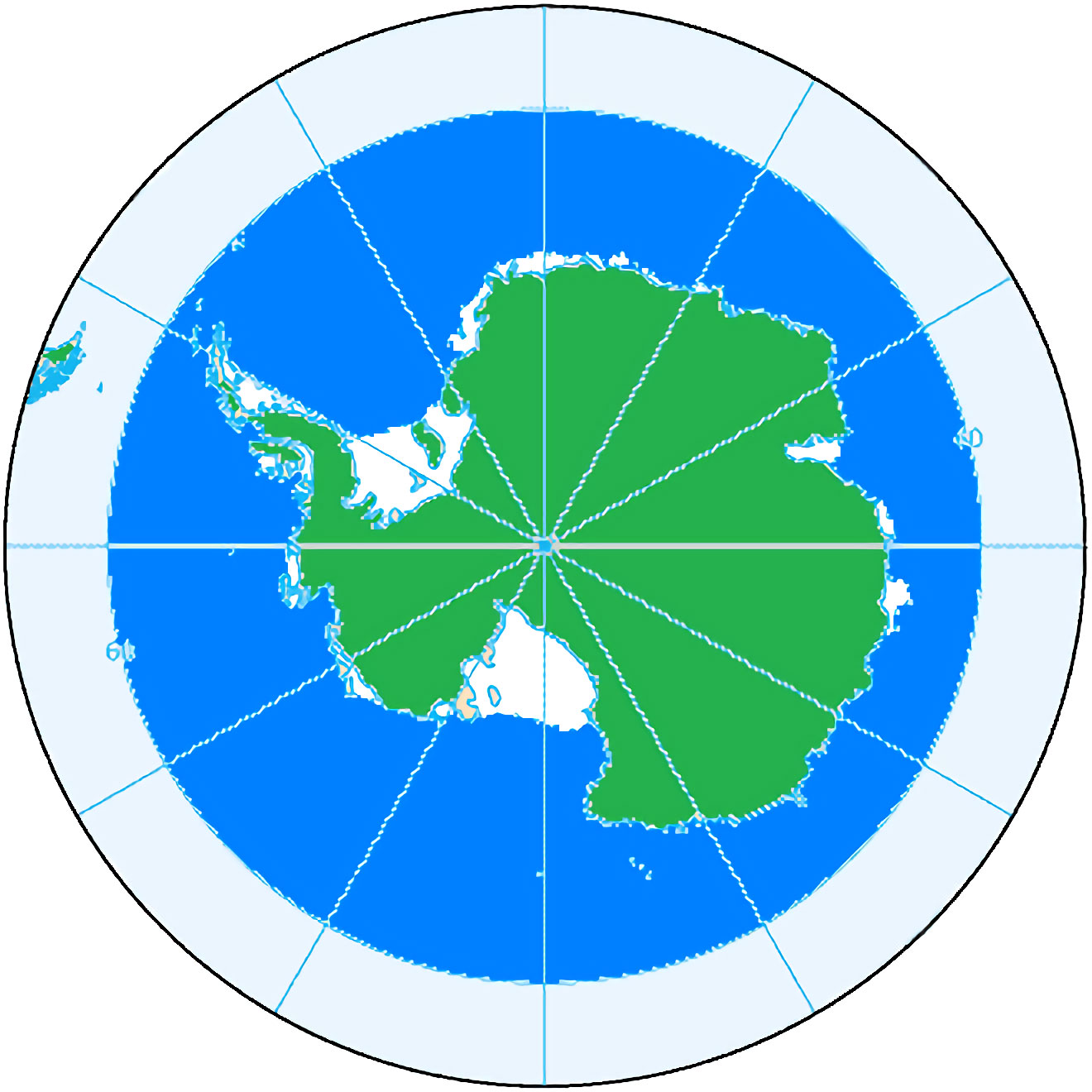
Southern Ocean
Formation of the oceans
Today (2022) in the scientific community there is a version that the ocean was formed 3.5 billion years ago as a result of the degassing of magma (degassing is the removal, removal of toxic substances or gases from somewhere) and the resulting condensation of vapors into the atmosphere. Most of the modern ocean basins were formed over the past 250 million years as a result of the breakup of an ancient supercontinent and the scattering of lithospheric plates in all directions (so-called spreading). With the exception of the Pacific Ocean, this ocean represents the shrinking remnant of the ancient Panthalassa Ocean.
Bathymetric position
Depending on the bathymetric position (bathymetry is the study of the underwater part of water basins) and the nature of the relief, several levels are distinguished on the ocean floor:
- shelf (shallow coastal area of the ocean) - depth up to 200-500 m;
- continental slope - depth up to 3500 m;
- ocean floor or trench (Russian: ложе) - depth up to 6000 m;
- deep pits - depth below 6000 m.
Ocean and atmosphere
The ocean and atmosphere represent an unstable, changing environment. The properties of these environments determine the habitat of organisms. Currents in the atmosphere affect the general circulation of water in the ocean, and the properties of ocean waters depend on the composition and temperature of the air. In turn, the ocean determines the main properties of the atmosphere and is a source of energy for many processes in it. The circulation of water in the ocean is influenced by winds, the Earth's rotation, as well as land barriers.
Ocean and climate
The ocean warms slowly in the summer and cools slowly in the winter. This allows the ocean to compensate for temperature fluctuations on land adjacent to it.
The atmosphere receives most of the heat and almost all of the water vapor from the ocean. The vapor rises and condenses to form clouds, which are carried by winds toward land and fall to the ground as rain or snow. Only the ocean's surface waters participate in the exchange of heat and moisture. Deep-sea waters, which make up about 95% of the Earth's ocean volume, do not participate in the exchange. Evaporation is a physical process: the salts remain in the ocean, while the vapor contains almost no salts. The resulting precipitation forms the main source of fresh water.
Chemical composition
The ocean contains an inexhaustible source of chemical elements, both in its water and in deposits on the ocean floor. The mineral reserves are constantly replenished by the deposition and transport of various sediments and solutions from the Earth's crust.
The average salinity of seawater is 35‰ (or 3.5%). The salty taste is due to the dissolved minerals, mainly compounds of sodium and chlorine.
Due to waves and currents, the water in the ocean is constantly mixed, and its composition is almost the same in all parts of the ocean.
Flora and Fauna
The Pacific Ocean accounts for 50% of the total biomass of the World Ocean. Life in the ocean is abundant and diverse, especially in the tropical and subtropical regions between the coasts of Asia and Australia, where large areas are occupied by coral reefs and mangroves. The phytoplankton of the Pacific Ocean is mainly composed of unicellular microscopic algae, with about 1,300 species identified. In the tropics, fucus, large green and especially well-known red algae are widespread, which, along with coral polyps, are reef-forming organisms.
The flora of the Atlantic is distinguished by its species diversity. The water column is dominated by phytoplankton, consisting of dinoflagellates and diatoms. During their bloom, the coast of Florida is painted in bright red, and one liter of seawater contains tens of millions of unicellular plants. The bottom flora is represented by brown (fucus, kelp), green, red algae, and some sea grasses (or vascular plants). Sea kelp grows at the mouths of rivers into the sea, and in the tropics there are green (caulerpa, valonia) and brown algae (sargasso). Brown algae are characteristic of the southern parts of the ocean (fucus, lessonsonia, electus). The fauna is distinguished by a large number (about a hundred) of bipolar species, which live only in cold and temperate zones. First of all, these are large marine animals (whales, seals, fur seals) and ocean birds. In the tropical latitudes live sea urchins, polyps, sharks, parrotfish and surgeonfish. Dolphins are common in the waters of the Atlantic. These cheerful intellectuals of the animal world are willing to accompany ships, large and small, but unfortunately, they are sometimes struck by ship propellers. The native inhabitants of the Atlantic are manatees and the largest mammal on the planet - the blue whale.
The flora and fauna of the Indian Ocean are particularly diverse. The tropical part is distinguished by its richness in plankton. The unicellular algae Trichodesmium (a type of cyanobacteria) is especially abundant, due to which the surface layer of the water is very turbid and changes color. The plankton of the Indian Ocean is also distinguished by a large number of organisms that emit light at night: peridinoids, as well as some species of jellyfish, comb jellies (ctenophores), and tunicates. There are many brightly colored siphonophores, including poisonous physalis. In temperate and arctic waters, the main representatives of plankton are copepods, euphuazids, and diatoms. The abundant fish of the Indian Ocean include dolphinfish, tuna, notothens, and various sharks. Among the reptiles, there are several giant sea turtles, sea snakes, and among mammals - cetaceans (toothless and blue whales, sperm whales, dolphins), seals, and elephant seals. Most cetaceans live in temperate and subpolar regions, where, due to intensive mixing of waters, favorable conditions are created for the development of planktonic organisms. The flora of the Indian Ocean is represented by brown (sargassum, turbinaria) and green (Caulerpa) algae. Calcareous algae such as Lithothamnia and Halimeda are also actively developing, which, together with corals, participate in the formation of reef structures. The coasts of the Indian Ocean, formed by mangroves, are characterized by phytocenosis. Temperate and subantarctic waters are characterized by red and brown algae, mainly fucus and kelp, porphyry, and gelidium. Giant macrocystis is found in the subpolar regions of the Southern Hemisphere.
The reason for the poverty of the organic world of the Arctic Ocean is the harsh climatic conditions. The North European Basin, the Barents, and the White Seas are exceptions, as their animal and plant life is rich. The ocean flora is represented mainly by kelp, fucus, and anfeltsia, and in the White Sea - by zostera. The benthic fauna of the eastern Arctic seas is very poor, especially in the central part of the Arctic Basin. There are more than 150 species of fish in the Arctic Ocean, most of which are food-producing (herring, cod, salmon, scorpionfish and flounder, etc.). Seabirds in the Arctic lead a predominantly colonial lifestyle and live mainly on the coasts. Mammals are represented by seals, walruses, belugas, whales (mainly bowhead and bowhead whales), narwhals. Lemmings are found on the islands, and arctic foxes (blue or white foxes) and reindeer traverse the sea ice. The polar bear is also considered a representative of the ocean fauna, whose life is mainly associated with drifting (pack) and stationary (freezing) ice on the coast. The color of most animals and birds is white or gray all year round (some only in winter).
Extraterrestrial oceans
The World Ocean is not considered the largest in the Solar System: There are also a number of subglacial oceans on other icy moons and dwarf planets. Some of these oceans (the Galilean moons Europa, Ganymede, and Callisto, as well as the oceans of some dwarf planets) are several times larger than the World Ocean, while others (the oceans of Europa and Enceladus) may be capable of supporting extraterrestrial life. In the foreseeable future, all of these oceans are inaccessible to humanity, since to reach them it would be necessary to melt tens of kilometers of the Earth's crust.
The ice giants Uranus and Neptune may have even larger liquid oceans.
Other star systems also have ocean planets that are completely covered in ice, or, if the planet is in the habitable zone, have oceans with liquid water.
If humans are destined to become a spacefaring species, the oceans could become a major source of extraterrestrial life.
Related links