Water cycle: what is it, evaporation, condensation, precipitation, collection
📥 Download PDFWater cycle is the continuous movement of water between the Earth, the sky, and the oceans. The solar energy drives evaporation, it forms clouds, falls as precipitation, and flows back into water bodies. This process endlessly purifies and redistributes the water necessary for life.
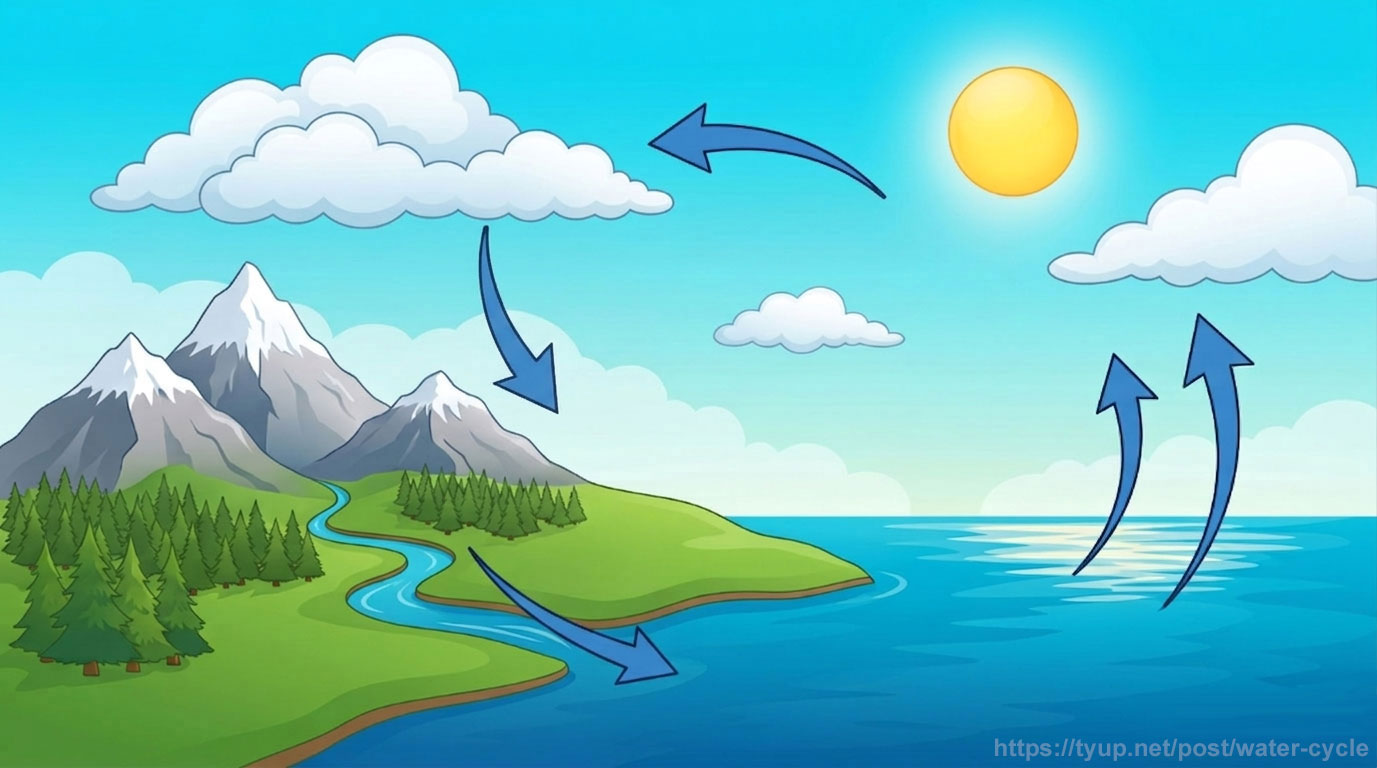
The water cycle consists of four main stages: evaporation, condensation, precipitation, and collection. Solar energy turns water into vapor (evaporation), which forms clouds (condensation), falls back as rain or snow (precipitation), and gathers in oceans or soil (collection). These stages ensure the continuous circulation and natural filtration of water across the planet.

The full water cycle consists of six stages: evaporation, transpiration, condensation, precipitation, infiltration, and runoff. Water rises from surfaces (evaporation) and plants (transpiration), forms clouds (condensation), falls as rain (precipitation), soaks into the ground (infiltration), and flows into oceans (runoff).These stages work together to ensure the continuous movement and replenishment of water resources worldwide.
The simplified water cycle includes four stages: evaporation, condensation, precipitation, and collection. Water evaporates, forms clouds, falls as rain, and gathers in oceans, rivers, and lakes. This basic model clearly explains how water endlessly circulates in nature.
Why 4 or 6 stages? The number of stages depends on whether the cycle is viewed as a basic model or a detailed scientific process. The 4-stage model focuses on general movement (evaporation, condensation, precipitation, collection), while the 6-stage model adds specific details like transpiration (from plants) and infiltration (water soaking into the ground). Both versions are correct; the 4-step version is for simplicity, and the 6-step version is for a complete scientific understanding.
The Sun is the primary source of energy that powers and drives the entire water cycle on Earth. Solar radiation heats the surface of oceans and land, providing the necessary thermal energy to break molecular bonds and trigger evaporation. Without the Sun’s constant energy input, the water cycle would stop completely; water would remain stagnant and frozen, and the planet’s weather systems would cease to exist.
Water cycle diagram and simulator, interactive.
Water Cycle Steps In Detail
Water cycle steps are the sequential stages through which water moves between the Earth, the atmosphere, and the oceans. These steps include evaporation (rising vapor), condensation (forming clouds), precipitation (rain or snow), and collection (return to water bodies). This constant sequence creates a closed system that ensures water is never lost, only recycled.
Evaporation
Evaporation is the process by which liquid water turns into water vapor. Solar energy heats the surface of oceans and lakes, causing water molecules to rise into the atmosphere as an invisible gas. This stage is the primary way water moves from the Earth's surface back into the air to start the cycle.
Transpiration is the process by which moisture is carried through plants from roots to small pores on the underside of leaves. Plants absorb water from the soil and release it into the atmosphere as water vapor through their leaves to stay cool and move nutrients. This "plant sweating" contributes significantly to the amount of water vapor in the air, acting as a biological pump for the water cycle.
Transpiration is a biological form of evaporation. While standard evaporation occurs from water bodies, transpiration is the process of water evaporating from plant leaves. Both processes transform liquid water into vapor, contributing to the moisture in the atmosphere.
Condensation
Condensation is the process where water vapor cools down and turns back into liquid water. As water vapor rises higher into the atmosphere, the cooler temperatures cause the gas molecules to clump together, forming clouds or dew. This stage is essential because it transforms invisible moisture into visible forms, preparing the water to fall back to Earth.
Precipitation
Precipitation is any form of water that falls from the atmosphere to the Earth's surface. When cloud droplets or ice crystals become too heavy to stay suspended in the air, they fall due to gravity as rain, snow, sleet, or hail. This stage is the primary delivery system for fresh water to the planet's land and oceans.
Infiltration
Infiltration is the process by which water on the ground surface enters the soil. When precipitation falls, some of the water soaks into the cracks and pore spaces of rocks and soil to reach underground aquifers. This stage is vital for replenishing groundwater and providing moisture for plants to grow.
Runoff
Runoff is the flow of excess water from precipitation that moves over the land surface instead of soaking into the ground. When the soil is saturated or the surface is impermeable (like rock or pavement), water flows downhill into streams, rivers, and eventually the oceans. This stage is the final link that returns water to larger bodies of water, completing the cycle and reshaping the landscape through erosion.
Water cycle types
Water cycle types are a classification of moisture movement pathways, categorized into three main forms: Minor (Oceanic), Major (Global), and Internal (Continental). Each type incorporates evaporation, vapor transport, condensation, and runoff, but differs based on geographical scale and whether the process involves the ocean, land, or both. This classification allows for a precise assessment of the water balance across different regions and the planet as a whole.
Minor (Oceanic) Water Cycle
The minor water cycle is a closed moisture loop that begins and ends over the surface of the World Ocean. Water evaporates from the sea surface, forms clouds in the lower atmosphere, and returns as precipitation directly back into the same ocean without reaching land. This type is the fastest in terms of turnover and accounts for the largest volume of evaporated water on Earth.
Major (Global) Water Cycle
The major water cycle is a global moisture exchange process that connects the World Ocean with the continents. Oceanic moisture is transported by air masses to land, falls as precipitation, and eventually returns to the ocean through rivers, glaciers, and groundwater. The major cycle serves as the primary mechanism for replenishing freshwater reserves across the entire planet.
Internal (Continental) Water Cycle
The internal water cycle is a moisture circulation loop confined strictly within continental territories. Water evaporates from the surface of inland rivers, lakes, forests, and soil, then condenses and falls as precipitation on the same landmass without reaching the ocean. This cycle is critical for sustaining ecosystems in regions far from the sea and depends heavily on local vegetation and forest cover.
Global Water Distribution
Global water distribution is the quantitative ratio of all water reserves in the hydrosphere, categorized by their location and physical state. This concept describes what percentage of the planet's total water volume is held in saline oceans, glaciers, underground aquifers, surface water bodies, and atmospheric vapor. Analyzing this distribution allows for the assessment of the actual volume of available water resources required for human survival.
Global water distribution determines the volume of resources involved in the active phases of the water cycle. While most water is "locked" in stable reservoirs like oceans and glaciers, only a small fraction (vapor and rivers) moves constantly to sustain life on land. Any shift in distribution, such as glacier melt, immediately alters the intensity and pathways of the entire water cycle.
The vast majority of Earth's water is concentrated in the World Ocean, leaving only a tiny fraction as freshwater. Approximately 97% of all water on the planet is saline, while only about 3% is classified as freshwater necessary for human life and terrestrial species. The massive total volume of water on Earth masks a critical scarcity of resources suitable for direct consumption.
Status of Freshwater Reserves
Main article: Drinking Water
The status of freshwater reserves is a quantitative and qualitative measure of moisture availability with low salt concentration, suitable for life and economic activities. This term describes the form (liquid, solid, or gas) and the reservoirs (glaciers, rivers, aquifers) where freshwater is concentrated at any given moment. The current status of reserves is characterized by extreme distributional inequality and the dominance of hard-to-access forms, such as glacial ice.
Most of the planet's freshwater is locked away in a frozen or hidden state, making it inaccessible for immediate use. Nearly 69% of freshwater is held in glaciers and ice caps, while about 30% is stored deep underground as groundwater. Humanity relies on less than 1% of the world's freshwater reserves found in rivers, lakes, and the atmosphere.
Water Renewal Residence Time
Water residence time is the average duration a water molecule remains within a specific reservoir of the hydrosphere, such as the atmosphere, ocean, or glaciers. This value is calculated by dividing the total volume of water in a reservoir by the rate of its inflow or outflow within the water cycle. This parameter makes it possible to estimate how quickly water resources are renewed and how long pollutants might persist within them.
Different components of the hydrosphere renew themselves at vastly different rates during the water cycle. Atmospheric water is completely replaced every 9 days, whereas the full renewal of the World Ocean or deep glaciers takes thousands of years. The replenishment rate of water resources in any given region depends strictly on which part of the water balance they occupy.
The Role of the Water Cycle in the Planet Energy
The role of the water cycle in the planet's energy budget consists of the global absorption, transport, and release of thermal energy through the phase transitions of water. Water acts as a heat carrier that absorbs solar energy during evaporation in the tropics and releases it into the atmosphere during condensation in cooler latitudes. Without this process, Earth's thermal balance would be disrupted, leading to extreme overheating at the equator and total freezing at the poles.
Latent Heat Mechanism Of Vaporization
The latent heat mechanism of vaporization is the process of energy absorption or release during water's transition between liquid and gas states without a change in temperature. During evaporation, water molecules absorb thermal energy to break intermolecular bonds, "storing" it within the vapor; during condensation, this stored energy is released back into the environment. This mechanism serves as the primary method for energy storage and transfer within the Earth's hydrosphere and atmosphere.
The latent heat of vaporization is the primary tool for cooling the Earth's surface. Enormous amounts of solar heat are consumed to break molecular bonds as water turns into vapor, preventing a critical rise in the temperature of the world's oceans. Evaporation functions as the planet's natural air conditioning system, channeling excess heat into the atmosphere.
Global Heat Transport In Water Cycle
Global heat transport in the water cycle is the process of moving thermal energy from equatorial latitudes to the polar regions through the movement of atmospheric water vapor. Moisture evaporated in the hot tropics accumulates solar energy and is transported by winds to cold regions, where this heat is released during precipitation, warming the surrounding air. This mechanism serves as the primary regulator of the planetary climate, preventing a critical temperature gap between different climatic zones.
The water cycle ensures the movement of energy from equatorial zones to the polar regions. Moisture-saturated air masses travel thousands of kilometers, carrying accumulated thermal energy to parts of the Earth where solar radiation is insufficient. The hydrological cycle levels out the climate, making vast continental territories suitable for life.
The energy released within the water cycle
The energy released within the water cycle is the thermal energy discharged into the atmosphere as water vapor transitions back into a liquid or solid state (condensation and deposition). When water vapor cools to form rain droplets or ice crystals, the "latent" energy previously absorbed during evaporation is released, warming the surrounding air and creating low-pressure zones. This energy discharge acts as the "fuel" for atmospheric circulation, powering the formation of clouds, winds, and intense storm systems.
The energy released within the water cycle is the driving force behind most meteorological phenomena. When vapor condenses into clouds, a colossal amount of energy is released, fueling winds, cyclones, and powerful storm systems. The water cycle transforms solar radiation into the mechanical energy of the atmosphere, determining the dynamics of global weather.
Extraterrestrial Water Cycle
The extraterrestrial water cycle is the process of water movement and phase transitions on celestial bodies driven by local temperature and pressure conditions. Unlike Earth's cycle, these processes may involve direct ice-to-vapor sublimation or the ejection of water from subsurface oceans into space via geysers. The existence of these cycles confirms that physical laws are universal, even under extreme environmental conditions.
The study of water cycles on other planets is conducted by planetary scientists and astrobiologists using interplanetary probes and orbital telescopes. Critical data have been provided by missions such as NASA's Curiosity and Cassini, and ESA's Mars Express, alongside research by scientists like Christopher McKay, who focus on the search for water in the solar system. The work of these experts has moved humanity from hypotheses to precise mapping of water reserves and understanding the dynamics of its movement.
The Water Cycle on Mars (Sublimation Type)
On modern-day Mars, the classic water cycle has been replaced by a cycle of ice sublimation and deposition due to extremely low atmospheric pressure. Water cannot exist in liquid form on the surface; instead, it turns directly from ice into vapor (sublimation) at the poles during summer, is transported by winds, and settles again as frost in colder regions. The Martian cycle is "open-ended" and extremely slow, which prevents the formation of rivers or oceans in the current epoch.
The Water Cycle on Europa and Enceladus (Cryovolcanic Type)
On the icy moons of Jupiter and Saturn, the water cycle occurs between the subsurface ocean and outer space. Giant geysers erupt through cracks in the icy crust (cryovolcanism), where part of the water falls back as "snow," while another part escapes into space, contributing to the formation of planetary rings. This type of cycle proves the existence of active internal heat sources and massive reserves of liquid water beneath the ice layer.
The Water Cycle on Exoplanets (Extreme Type)
On planets beyond our Solar System, the water cycle can take extreme forms depending on gravity and proximity to the host star. On hot "Super-Earths," water may exist in a supercritical fluid state, where there is no clear boundary between gas and liquid, creating a continuous, global thick mist. The diversity of water cycle types in the universe is limited only by the temperature regimes and chemical compositions of planetary atmospheres.
Methods for studying and monitoring the water cycle
Methods of studying and monitoring the water cycle are a collection of remote and contact observation tools used to track the movement of water masses in the hydrosphere and atmosphere. These methods allow for the collection of precise data on precipitation, evaporation, groundwater levels, and glacier conditions to model climate change. The use of a unified monitoring system is essential for the rapid forecasting of droughts and floods, as well as for the rational management of water resources.
Remote Sensing (Satellites)
Satellite methods have been the primary tool for global observation of the water cycle since the late 20th century. Missions such as GRACE (launched in 2002) measure changes in Earth's gravity to estimate groundwater reserves, while GPM satellites (since 2014) track global precipitation every 3 hours. Space-based monitoring has provided a complete picture of water distribution in inaccessible areas like the open ocean and the poles.
Hydrometric and Ground-Based Methods
Ground-based monitoring stations provide the most accurate local data on river discharge and soil evaporation. The Argo sensor network (over 3,800 buoys in the ocean) and stationary gauging stations measure temperature, salinity, and flow velocity in real-time. Combining ground-based data with computer models (such as ECMWF models) allows for weather forecast accuracy of up to 90% in the short term.
Human impact on the water cycle
Human activities significantly alter the natural flow and quality of the water cycle. Urbanization and deforestation increase surface runoff by creating impermeable surfaces, while excessive groundwater pumping and pollution disrupt the natural infiltration and purification processes. These interventions can lead to more frequent flooding, water scarcity, and long-term changes in local and global climates.
Urbanization
Urbanization is the transformation of natural landscapes into dense city environments with man-made structures. Replacing soil and vegetation with "impermeable" surfaces like concrete and asphalt prevents infiltration and forces water to become rapid surface runoff. This shift disrupts the natural balance, leading to lowered groundwater levels and an increased risk of flash flooding in urban areas.
Land Use Changes
Land Use Change refers to the human modification of the Earth's surface for agriculture, grazing, or industrial purposes. When natural ecosystems like forests or wetlands are converted into farms or pastures, the soil's ability to absorb water changes, often reducing infiltration and increasing surface runoff. These modifications disrupt the regional water balance, often leading to soil erosion and changes in local humidity and rainfall patterns.
Deforestation
Deforestation is the large-scale removal of trees and forest ecosystems by human activity. Without trees, there is less transpiration to moisten the air and fewer roots to hold the soil, which reduces infiltration and causes water to wash away quickly as runoff. This imbalance leads to a drier local climate (fewer clouds and rain) and increases the risk of soil erosion and severe flooding.
Water Extraction And Overuse
Water Extraction is the process of taking water from surface or underground sources for human use. Humans pump vast amounts of water from rivers, lakes, and aquifers for irrigation, industry, and drinking, often faster than the natural cycle can replenish them. Excessive extraction leads to depleted groundwater levels, drying up of wells, and the shrinking of entire bodies of water (like the Aral Sea).
Water Overuse occurs when human consumption of water exceeds the natural rate of replenishment within the water cycle. Excessive water use in agriculture, industry, and households leads to the rapid depletion of groundwater (aquifers) and the shrinking of surface water bodies like lakes and rivers. This imbalance disrupts the local water cycle, leading to permanent water scarcity, land subsidence (sinking ground), and the destruction of aquatic ecosystems.
Pollution
Pollution is the introduction of harmful substances into the water cycle through human activity. Chemicals from factories, fertilizers from farms, and plastic waste enter rivers and oceans, while air pollution creates acid rain during the condensation and precipitation stages. This degrades water quality, making it toxic for ecosystems and humans, effectively "poisoning" the natural recycling process.
Global Warming And Climate Change
Global Warming and Climate Change are often used as synonyms, but they represent different aspects of environmental change. Global Warming specifically refers to the long-term increase in Earth’s average temperature, while Climate Change is a broader term that includes warming and all its side effects, such as melting glaciers, heavier rainstorms, or more frequent drought. In the context of the water cycle, Global Warming is the cause (increased evaporation), and Climate Change is the result (shifted precipitation patterns).
Global Warming is the unusually rapid increase in Earth’s average surface temperature over the past century. Higher temperatures increase the rate of evaporation, which puts more water vapor into the atmosphere and heats up the oceans. This "supercharges" the water cycle, making the entire process faster and more intense than it was naturally.
Climate Change refers to the long-term shifts in temperatures and weather patterns, largely driven by global warming. It shifts where and when precipitation falls, leading to some areas getting extreme floods while others suffer from permanent droughts. This disruption makes the water cycle unpredictable, threatening the reliability of water supplies for farming, nature, and people.
Historical Overview
The Water Cycle History is a collective scientific achievement spanning centuries, rather than the work of a single discoverer. It began with the conceptual theories of Bernard Palissy (16th century), was validated through the physical measurements of Pierre Perrault and Edme Mariotte (17th century), and was completed by Edmond Halley's (17th–18th century) study of solar-driven evaporation. This timeline shows a transition from philosophical observation to empirical measurement, and finally to a global thermodynamic understanding of how water moves.
Bernard Palissy (16th century) was one of the first scientists to correctly describe the natural water cycle. In a time dominated by ancient theories, he used direct observation of nature to challenge the established views of the 16th century. His work laid the conceptual foundation for modern hydrology long before it could be measured.
Palissy explained that rain is formed through the process of evaporation. He identified the crucial link between surface water heating up, rising as vapor, and returning to Earth as precipitation. This insight correctly identified the atmosphere as the primary "transport system" for the planet's water.
He argued that rivers are fed by rainwater rather than mysterious underground oceans. At the time, most people believed in the "Great Abyss" (massive subterranean reservoirs) feeding rivers; Palissy proved that rainfall soaking into the ground was the true source. By debunking the "underground ocean" myth, he redirected scientific focus toward the study of soil infiltration and runoff.
Pierre Perrault (17th century) was the first to quantitatively measure rainfall and river flow in the Seine River basin. He set up a scientific experiment to compare the total volume of rain falling over a specific area with the actual amount of water flowing in the river over one year. This provided the first empirical data to replace ancient guesses with hard scientific facts.
Perrault proved that precipitation alone is sufficient to supply the water found in rivers. His calculations showed that rainfall was actually six times greater than the river's flow, confirming Bernard Palissy’s earlier theories and debunking the idea that rivers came from mysterious underground oceans. This discovery was the "birth of modern hydrology," establishing the logical link between rain, runoff, and river systems.
Edme Mariotte (17th century, colleague of Perrault) expanded the scientific study of evaporation and precipitation following Pierre Perrault’s work. He conducted more precise experiments and observations on how water moves through the atmosphere, confirming that the amount of water falling as rain was consistent with the amount flowing in rivers and springs. By repeating and refining these measurements, he turned a single discovery into a verifiable scientific trend.
Mariotte's work was instrumental in solidifying the modern scientific understanding of the water cycle. As a founding member of the French Academy of Sciences, he used his influence and rigorous methods to prove that the cycle was a closed, continuous physical process governed by natural laws. His support moved the water cycle theory from a debated hypothesis to an established scientific fact accepted by the global community.
Edmond Halley (17th–18th century) conducted the first systematic study of evaporation from the ocean surface. He calculated the vast amount of water that evaporates from the Mediterranean Sea daily, proving that the atmosphere receives enough moisture to account for all the rain and river flow in the world. This provided the "input" data for the global water budget, balancing what Perrault had measured as "output" (rivers).
He was one of the first to explain how solar energy drives the movement of water in the atmosphere. Halley identified that the sun's heat is the primary "engine" that lifts water vapor into the air, creating a thermal exchange that keeps the cycle in constant motion. This shifted the understanding of the water cycle from a simple mechanical flow to a complex thermodynamic system powered by the sun.
Halley linked evaporation to the formation of winds and circulation patterns. He realized that as water evaporates and moves, it is carried by winds (which he also mapped), connecting the water cycle to global weather systems. His work unified hydrology and meteorology, showing that the water cycle is a global, interconnected atmospheric process.
Following the 18th century, the water cycle was recognized as a global, closed-loop system integrated with the Earth's climate and biology. In the 19th and 20th centuries, scientists added the "missing links": John Dalton quantified the physics of evaporation, and later researchers discovered the role of groundwater flow (Darcy's Law) and transpiration from plants. Today, we view the water cycle not just as moving water, but as a complex process of energy transfer that is being rapidly altered by human activity.
How to use it
Knowing the principles of the water cycle allows us to use it for environmentally friendly benefits. For example, we know that rain falls mainly where air rises (in mountains and on slopes), where there are large bodies of water (oceans, seas, and lakes), where there is abundant vegetation (forests), and where moist air masses pass through. In such places, it is most effective to install water-collection systems, grow moisture-loving plants, generate electricity, irrigate farmland, support ecosystems, and contribute to climate regulation.
What we don’t know
Despite all we know about the water cycle, some details remain uncertain. Scientists are still studying exactly how small changes in climate, soil, and vegetation can influence local precipitation patterns and groundwater levels.
Dew Point and Condensation Calculator
Essential for water cycle researchers and hikers to predict dew, fog, and cloud formation levels.