Liquid
📥 Download PDFLiquid — is a state of matter that combines the properties of both solids and gases. It occupies an "intermediate" position between the solid and gaseous states of matter. It is no longer as rigid as ice, yet not as free as vapor.
Liquids have three main characteristics: fluidity and shape, constant volume, and practical incompressibility.
Fluidity and shape of a liquid. A liquid has no shape of its own. It takes the shape of the container it is poured into (a glass, a bucket, a puddle). At the same time, under the influence of gravity, it always tends to occupy the bottom of the container.
Constant volume. Unlike gas, which expands to fill all available space, a liquid maintains its volume. If you have 1 liter of water, it remains a liter in both a bottle and a plate (unless, of course, it evaporates).
Practical incompressibility. Compressing a liquid is extremely difficult. There is almost no free space between the molecules, so even if you push hard on a piston with water, its volume will barely change. This property is used in hydraulics (for example, in car brakes).
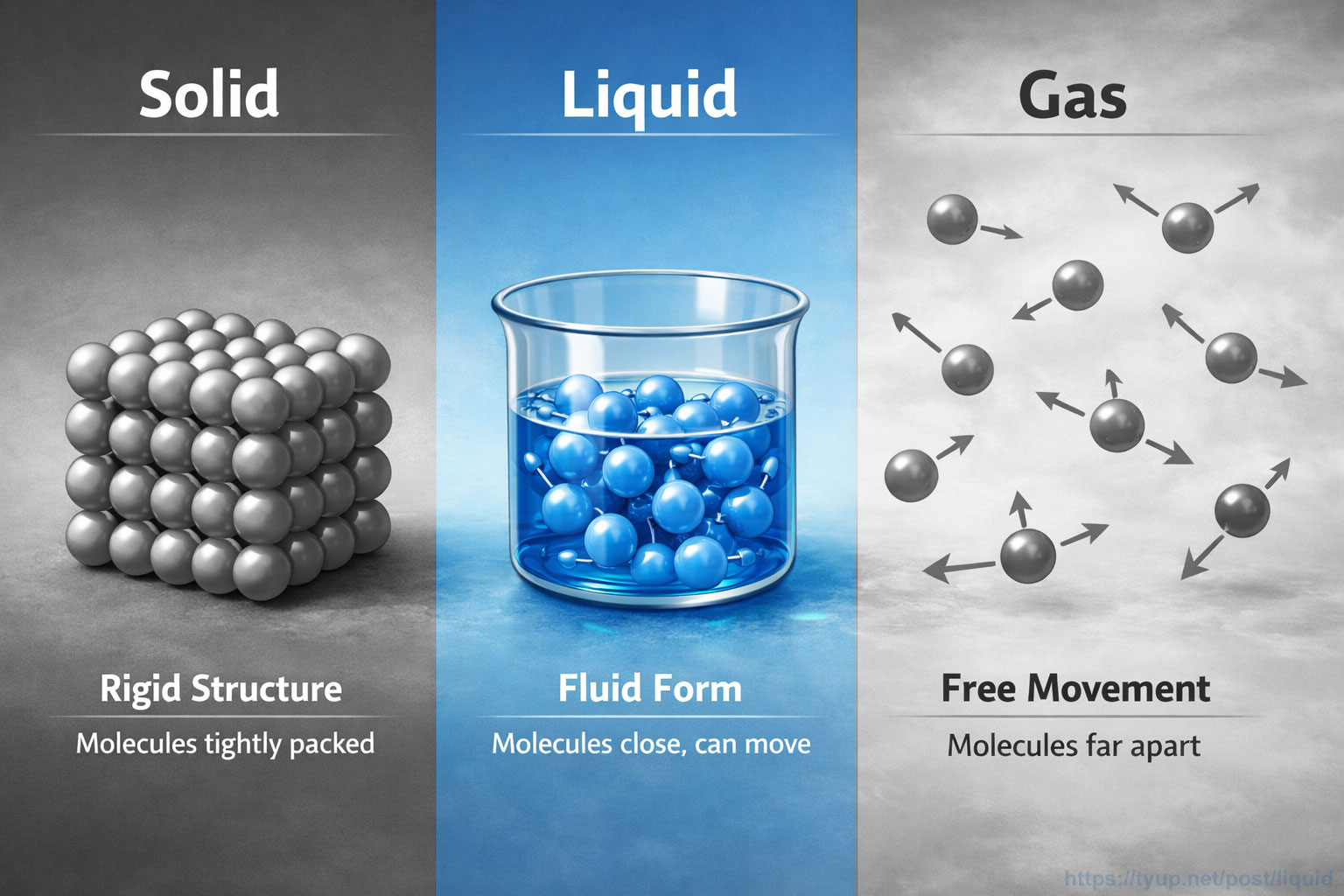
What does a liquid look like at the atomic level? Imagine the structure of matter as the behavior of people in a crowd:
- Solid: People are sitting in a movie theater in their assigned seats. They can only sway slightly, but they cannot leave.
- Liquid: This is a subway lobby during rush hour. Everyone is pressed against each other, but at the same time, they can slowly move and change places. It is this "crawling" of molecules over each other that creates the flow effect.
- Gas: People in a huge empty square. Everyone runs wherever they want and rarely bumps into others.
Unique properties of liquids. Liquids have "special features" that other states of matter do not have:
- Viscosity: "Internal friction." Slow flowability (compare how water pours versus how honey stretches).
- Surface tension: Molecules on the surface hold onto each other so tightly that they create a kind of "skin." Thanks to this, water striders can run on water without falling through.
Not just water. We are used to thinking of liquids as water or juice. But at certain temperatures, almost anything can become a liquid:
- Mercury is a metal that remains liquid even at room temperature.
- Lava is molten rock.
- Liquefied gases (for example, liquid nitrogen).
A liquid particle is an elementary macroscopic volume of matter considered as a single whole. It consists of many molecules, which allows us to assign it general properties (density, velocity, pressure) without being distracted by the motion of each individual atom. This is a basic model that allows us to describe a liquid as a continuous medium (flow) rather than a set of chaotic particles.
In chemistry, a liquid is a condensed state of matter characterized by short-range order in the arrangement of particles and high molecular mobility. Unlike gases, the intermolecular attraction forces in liquids (hydrogen bonds, Van der Waals forces) are strong enough to hold the particles together, but not strong enough to fix them in a rigid crystal lattice. This makes a liquid an intermediate link, combining the chemical density of solids with the isotropy (uniformity of properties in all directions) of gases.
Fluid or Liquid Viscosity Simulation
Adjust the slider to change the viscosity and observe how it affects the falling speed of the sphere.
Microscopic Structure
The microscopic structure of a liquid is a state of matter characterized by short-range order in the arrangement of particles and a lack of long-range order. Unlike gases, where molecules fly chaotically, in a liquid, they are packed almost as densely as in crystals. However, unlike solids, liquids do not have a rigid "framework." Molecules vibrate around a temporary center of equilibrium and then "jump" to a new location. This "settled life" time of a molecule is extremely short (10−11–10−12 seconds). Such a structure explains the duality: dense packing provides incompressibility, while constant molecular jumping ensures fluidity.
John Bernal (1960s) proposed the "random close packing" model. He proved that the structure of a liquid is similar to a pile of haphazardly dumped balls: there are almost no gaps, but there are no clear rows either.
Yakov Frenkel (1943) developed the modern kinetic theory of liquids. He introduced the concept of "relaxation time" (the time a molecule stays in one place). It was Frenkel who explained that on very short time scales, a liquid behaves like a solid.
Short-range order: If you look at a single molecule, its nearest neighbors are arranged in a regular pattern (just like in a crystal).
Lack of long-range order: If you move 5–10 molecules further away, there is no longer any regular pattern — chaos reigns there.
Comparison of structures:
| Property | Solid | Liquid | Gas |
|---|---|---|---|
| Arrangement | Long-range order | Short-range order | Total chaos |
| Motion | Vibrations in place | Vibrations + jumping | Free flight |
| Voids (Free space) | Almost none | ~3-10% of volume | 99% of volume |
Properties
A property of a liquid is a set of physical parameters that determine its ability to maintain volume, take the shape of a container, and resist deformation. Unlike gases and solids, the properties of liquids depend on the balance between molecular attraction forces and their thermal motion. Key parameters were discovered in different centuries: Blaise Pascal in 1653 justified the transmission of pressure, Isaac Newton in 1687 mathematically described viscosity, and Thomas Young in 1805 explained surface tension. The study of these properties allows humanity to manage energy flows in hydraulics, medicine, and construction by utilizing volume stability and molecular mobility.
Fluidity
Fluidity is the fundamental property of a liquid, expressed in its ability to change shape under the action of even insignificant external forces. Unlike solids, liquid molecules are not bound to a rigid crystal lattice and can move freely relative to each other. If you pour water into a pitcher, it will instantly take its shape, as it does not possess its own static form. This property makes liquids an ideal medium for transporting substances through pipes and filling any reservoirs with complex geometry.
Viscosity (Internal Friction)
Viscosity is the property of a liquid to offer resistance to the movement of one of its layers relative to others. When a liquid flows, its molecules "cling" to each other. Honey has high viscosity, so it flows slowly; water has low viscosity. As temperature increases, the viscosity of most liquids drops because the molecules begin to move faster and interact less with each other. Understanding viscosity is critically important for engineering: it determines the choice of engine oil and the power of pumps on oil pipelines.
Surface Tension
Surface tension is the tendency of a liquid to minimize its surface area. Molecules inside the liquid are attracted to each other from all sides, while those on the surface are only pulled inward. This creates the effect of a "stretched film." This is precisely why water droplets take the shape of a sphere and why water striders can run across the surface of a pond without falling through. This property determines how a liquid will wet surfaces and how capillary processes will function in plants and technology.
Incompressibility (Low Compressibility)
Liquids possess an extremely low ability to change their volume under increasing pressure. The distances between liquid molecules are so small that bringing them even closer together is almost impossible. To reduce the volume of water by just 1%, a colossal pressure of 200 atmospheres must be applied. Due to their incompressibility, liquids are used in hydraulic jacks and brakes: the force from the pedal is transmitted to the wheels instantly and without loss.
Blaise Pascal (1653) proved the incompressibility of liquids (the conservation of volume under pressure). If the volume cannot be reduced, it means that the applied pressure is transmitted throughout the entire volume without loss.
Isotropy
Isotropy is the uniformity of a liquid's physical properties (viscosity, thermal conductivity) in all directions. Since molecules in a liquid are arranged chaotically, there is no "preferred" axis along which it would flow better or worse. At any point in a liquid at rest, the properties will be identical regardless of where you point the measuring instrument. This property simplifies physical calculations, allowing a liquid to be considered a homogeneous medium in most practical tasks.
Volume
The volume of a liquid is a physical quantity that characterizes the amount of space occupied by a given substance and remains practically unchanged at a constant temperature. Liquid molecules are located close to each other, which prevents them from coming significantly closer (incompressibility) or flying apart in different directions. Unlike gases, a liquid does not occupy the entire vessel provided to it, but forms a free surface, maintaining its literage regardless of the shape of the container. Volume stability allows liquids to be used as standards of measurement (liter) and as a reliable tool for transmitting enormous forces in hydraulic machines.
Archimedes (3rd century BC) established a method for measuring the volume of complex-shaped bodies by immersing them in a liquid ("Archimedes' Principle"). The volume of the displaced liquid is exactly equal to the volume of the part of the body immersed in it. This made it possible for the first time to accurately measure volumes without complex mathematical calculations.
Research by Anders Celsius and other scientists showed (18th century) that the volume of a liquid does change, but only when heated or cooled. This became the basis for the creation of liquid thermometers.
Pressure
Pressure in a liquid (hydrostatic) is the force acting perpendicularly to a surface exerted by the weight of the overlying column of liquid. A liquid exerts pressure in all directions equally (Pascal's Law). The magnitude of this pressure depends only on the density of the liquid (ρ) and the height of the column (h). For every 10 meters of depth, water pressure increases by approximately 1 atmosphere. Since the pressure at depth is enormous, the bases of dams are made thicker than the upper parts, and submarines are built from high-strength steel.
Blaise Pascal (1653) established that pressure in a closed vessel is transmitted in all directions without change.
Simon Stevin (1586) discovered the "hydrostatic paradox" — the pressure on the bottom depends on the height of the liquid level, not on the weight of all the water in the vessel or its shape.
Hydrostatic pressure formula — P=ρ⋅g⋅h
Surfaces
The surface of a liquid is the interface between the liquid and a gas (or vacuum), which in a state of rest always tends to occupy a horizontal position. Under the action of gravity, the surface of a liquid in a wide vessel is always perpendicular to the plumb line vector. However, due to surface tension (discovered by Thomas Young in 1805), molecules at the boundary tend to contract, forming a semblance of an elastic film. Thanks to this property, a liquid can hold small objects heavier than water (needles, insects) on its surface.
Meniscus (curved surface) — this is the curvature of the liquid surface near the walls of a vessel, arising from the interaction between liquid molecules and the molecules of a solid.
There are two types of meniscus:
- Concave: The liquid "sticks" to the walls (wetting, e.g., water in glass).
- Convex: The liquid "runs away" from the walls (non-wetting, e.g., mercury in glass).
The shape of the meniscus determines the accuracy of measurements in laboratory glassware and the operation of capillary systems.
Capillary action — is the effect of the rising or falling of a liquid level in narrow tubes (capillaries) under the action of surface tension forces. The narrower the tube, the higher (with wetting) or lower (with non-wetting) the liquid level will be relative to the general level. The phenomenon was mathematically described by James Jurin in 1718. The nutrition of plants (the rise of sap from roots) and the operation of lamp wicks are based on this principle.
Sound Propagation
Sound propagation in a liquid is the process of transmitting mechanical vibrations (elastic waves) through a dense liquid medium. Since molecules in a liquid are packed much more densely than in gases, they transfer momentum to each other faster. Sound in a liquid is a series of compression and rarefaction zones that travel at a speed depending on the density and temperature of the medium. This property makes liquid an excellent conductor of energy, allowing sound to cover vast distances with minimal loss.
It is important not to confuse the speed of sound in water with that in liquids in general. Different liquids have different properties, and accordingly, the transmission speed in them will vary. Keeping this in mind will help avoid errors.
Below is a table comparing the speed of sound propagation in certain liquids:
| Liquid | Temperature | Speed of sound (m/s) |
|---|---|---|
| Distilled water | 25°C | ~1497 |
| Sea water | 25°C | ~1531 |
| Mercury | 20°C | ~1450 |
| Alcohol (ethanol) | 20°C | ~1180 |
| Glycerin | 20°C | ~1900 |
Speed of sound in water is approximately 1500 m/s, which is nearly 4.5 times faster than in air (340 m/s). Liquids possess low compressibility, so the elastic wave (sound) is transmitted from molecule to molecule almost instantly. The speed directly depends on temperature, salinity, and pressure: the higher these indicators, the faster the sound travels. High speed and low attenuation allow sound waves to travel thousands of kilometers underwater, making them the only effective means of communication in the ocean.
Attenuation and absorption of sound in liquids. In liquids, sound waves attenuate significantly slower than in a gaseous medium. Sound energy in water is lost weakly, especially at low frequencies. In the ocean, there are "deep sound channels" (SOFAR layers with specific temperatures) where sound can circulate over vast distances without dispersing. This property is used by whales to communicate across hundreds of kilometers and by the military to detect submarines.
Jean-Daniel Colladon and Charles Sturm (1827): Conducted the first accurate measurement of the speed of sound in water on Lake Geneva. They used an underwater bell and a flash of gunpowder, recording a result of 1435 m/s.
Echolocation (20th century): Following the sinking of the Titanic (1912), active development of sonars began. In 1914, Reginald Fessenden designed the first working sound generator for detecting icebergs.
Hydroacoustics: During World War I and World War II, the study of sound in liquids became a strategic discipline for detecting submarines.
Optical Properties
Optical properties of a liquid are a set of characteristics that determine the behavior of light as it passes through a liquid medium (refraction, reflection, absorption, and scattering). When light moves from air into a denser liquid, its speed drops, and the beam deflects — this is called refraction. Liquids can also absorb certain parts of the spectrum (which is why water appears blue) or scatter light if impurities are present. These properties allow liquids to be used in precision instruments (lenses, lasers) and help determine the composition of a substance by how it distorts light.
Classification of Liquids
In modern science, liquids are classified according to five main criteria: rheological (viscosity), physical (compressibility), model (friction), chemical, and electrical. There is no single number of "types," as the same liquid (for example, mercury) is simultaneously Newtonian, a conductor, and a metal.
Rheological Liquid (by Viscosity)
A rheological liquid is a complex medium whose viscosity changes depending on the force and speed of mechanical impact. Unlike simple liquids, its internal bonds rearrange under load, causing the substance to either liquefy (like paint) or instantly harden (like a mixture of starch and water). This is a model of an "inconstant" substance whose properties depend not on its composition, but on the method of impact upon it.
In turn, rheological liquids are divided into Newtonian and non-Newtonian. This classification was established by Isaac Newton in 1687 in his work "Philosophiæ Naturalis Principia Mathematica." He was the first to mathematically describe internal friction. For Newtonian liquids (water, gasoline), viscosity does not change with the force of impact, while for non-Newtonian liquids (blood, starch, house paint), it does. This division is the foundation of hydrodynamics, allowing simple liquids to be distinguished from complex structural mixtures.
Newtonian Liquid — is a viscous medium whose viscosity coefficient remains constant regardless of the shear rate or force applied. If you start stirring water or alcohol faster, they will not become "thicker" or "thinner" — the liquid's resistance will increase strictly in proportion to your effort. This happens because the structure of such liquids is simple and does not rearrange under external pressure. Thus, these are predictable liquids that obey Newton's classical law of viscosity, making them an ideal standard for most engineering calculations.Examples of Newtonian liquids: water, alcohol, oils. In these liquids, viscosity is always stable.
By the way, water is the benchmark Newtonian liquid with low viscosity. No matter how hard you hit the water or how fast you stir it with a spoon, it will not resist more than usual (it will not thicken). Its fluidity depends only on temperature, not on the applied force. This makes water an ideal standard for calibrating instruments and for basic calculations in hydrodynamics.
Non-Newtonian liquid — is a substance whose viscosity changes depending on the force, speed, or duration of mechanical impact. Unlike water, the structure of such a liquid (molecular chains or suspended particles) rearranges upon impact or stirring. As a result, the medium can either instantly "harden" (like a mixture of starch and water) or, conversely, become more fluid (like paint or ketchup). This is a "dynamic" medium whose properties depend on exactly how it is acted upon, which allows such liquids to be used in creating "smart" protection, dampers, and modern materials.
Examples of non-Newtonian liquids: dilatant (starch and water mixture), pseudoplastic (ketchup), complex biological medium (blood).
- Dilatant — this is a classic example of a liquid that hardens upon a sudden impact. If you slowly lower your hand into it, it feels like a thick jelly, but if you hit it with your fist, the surface becomes as hard as a board, because the starch particles do not have time to move aside and they block the movement. This example clearly shows how mechanical pressure temporarily turns a liquid structure into a solid support.
- Pseudoplastic — this is an example of a liquid that becomes fluid only when shaken or under pressure. At rest, it behaves like a thick jelly and does not flow out of a bottle, but once shaken, the internal bonds break, the viscosity drops, and it begins to flow. This effect allows the product to maintain its shape on a plate but be easily extracted from the packaging when necessary.
- Complex biological medium — using blood as an example, it is a non-Newtonian liquid whose viscosity depends on the diameter of the vessel. In large arteries, it flows like a common viscous liquid, but in the thinnest capillaries, its viscosity decreases, allowing red blood cells to "squeeze" through narrow gaps. This natural adaptation ensures efficient nutrition of body cells even in the most inaccessible places.
Model Liquid (by Friction)
A model liquid is a simplified theoretical representation of a substance used in science to simulate real-world processes. Instead of accounting for millions of factors present in a real substance, scientists create a "model" (for example, an ideal liquid) by discarding viscosity or compressibility to simplify mathematical calculations. This is an auxiliary tool that allows for predicting the behavior of flows in engineering and nature without overloading calculations with unnecessary details.
Within model liquids, science distinguishes between ideal and real liquids. The concept of an ideal liquid was introduced by Leonhard Euler in 1755 to simplify the equations of motion.
Ideal Liquid — is an imaginary model of a substance in which viscosity (internal friction) and compressibility are completely absent. In such a liquid, layers slide relative to each other absolutely freely, without losing energy to heat. This is a mathematical simplification created so that complex hydrodynamic equations can be solved on paper. This model serves as the foundation of theoretical physics, allowing for the description of the fundamental laws of flow motion without considering minor interfering factors.
Example: It does not exist in a pure form, but water far from the vessel walls is treated as ideal for quick calculations. The only physical analog is liquid helium (superfluid), which can flow through microscopic pores without resistance.
Real Liquid — is any actually existing substance that possesses viscosity and some degree of compressibility. When such a liquid moves, its particles interact with each other, creating a friction force. Because of this, the liquid resists flow and heats up during intensive stirring. Accounting for the properties of a real liquid is necessary for any practical construction: from designing a water tap to calculating an oil pipeline.
Example: Engine oil, honey, petroleum, ordinary water in engineering calculations. Any liquid you can touch or see in everyday life is a real liquid.
Physical Liquid (by Compressibility)
Compressible liquids are media capable of significantly changing their volume and density under the influence of external pressure. Under normal conditions, liquids compress poorly, but at ultra-high pressures (in the interiors of planets) or in a state close to gaseous, their density can change considerably. The term also applies to gas flows that, at immense speeds, behave like a compressible "liquid." Understanding compressibility is essential for high-precision engineering operating in extreme conditions, such as rocket engines or deep-sea vehicles.
Example: Liquefied gases (liquid nitrogen, liquid oxygen), water at extreme ocean depths.
Physical liquids, in turn, are divided into drip liquids (practically incompressible) and compressible liquids, as shown in the examples.
Drip liquids (water, alcohol) maintain their volume even under enormous pressure. However, in the 1820s, Hans Christian Ørsted experimentally proved that even water compresses (albeit by tiny fractions of a percent). Compressible liquids are found in conditions of extreme temperatures and pressures (for example, in the interior of Jupiter). This type of classification is critically important for calculating hydraulic presses and studying the physics of giant planets.
By Chemical Structure and Bonds
By chemical structure and bonds, liquids are classified into molecular, ionic, and metallic. Molecular liquids (water) consist of neutral molecules. Ionic liquids (salt melts, for example, NaCl at 801°C) consist of charged particles. Metallic liquids (mercury, molten iron) are characterized by an "electron gas." The chemical type determines the aggressiveness of the medium, its capacity as a solvent, and its participation in reactions.
By Electrical Conductivity
By electrical conductivity, liquids are classified into dielectrics, electrolytes, and liquid conductors. In the 1830s, Michael Faraday established the laws of electrolysis, categorizing substances by their ability to conduct current. Distilled water is an insulator, a salt solution is an electrolyte, and liquid mercury is a direct conductor. This classification is necessary for creating batteries, sensors, and protecting electrical grids from short circuits.
Phase Transitions
A phase transition is a physical process where a liquid changes into another state of matter (solid or gaseous) when temperature and pressure change. During the transition, a huge amount of energy is absorbed or released (latent heat), while the temperature of the substance itself remains unchanged until the entire volume has changed phase. Molecules either slow down and arrange themselves into a lattice (freezing) or break their bonds and fly apart (evaporation). Managing phase transitions allows us to create refrigeration units, steam turbines, and preserve food products.
Main types of liquid phase transitions: vaporization (boiling and evaporation), crystallization (freezing), and condensation.
Vaporization during a liquid phase transition is the process in which a substance changes from a liquid state to a gaseous state (vapor). The process involves breaking intermolecular bonds. For a molecule to leave the liquid, it must possess kinetic energy that exceeds the attractive forces of its neighbors. Vaporization occurs in two forms: evaporation (occurs from the surface at any temperature) and boiling (intense vapor formation throughout the entire volume upon reaching a specific temperature). Since the "fastest" molecules leave the liquid during vaporization, the average energy of those remaining drops — this leads to the cooling of the liquid (which is why we feel cold when stepping out of water).The boiling point directly depends on external pressure. In the mountains (where pressure is low), water boils at 70–80°C, while in pressure cookers (under high pressure), it boils at 120°C or higher. Denis Papin invented the first autoclave ("Papin's digester") in 1679, proving that under pressure, a liquid can be heated significantly above its normal boiling point.
Critical temperature is the temperature above which a liquid cannot be turned into a gas by any amount of pressure. It was discovered by Dmitri Mendeleev in 1860 (who called it the "absolute boiling temperature") and independently by Thomas Andrews in 1869.
Crystallization — is a phase transition in which a substance changes from a liquid state to a solid crystalline state with the release of heat. As a liquid cools, the kinetic energy of its molecules decreases. When this energy becomes less than the forces of intermolecular attraction, the particles stop moving chaotically and arrange themselves in a strict order, forming a crystal lattice. The process begins with the appearance of "nuclei" (crystallization centers) — microscopic solid particles or impurities. Crystallization allows for the production of ultra-pure materials and metals with specified properties by regulating the cooling rate.For pure substances, the crystallization temperature coincides with the melting point. Until all the liquid has turned into ice/metal, the temperature of the mixture remains constant.
In the 18th century, Joseph Black proved that this process releases specific heat of crystallization — the energy that previously held the molecules in a liquid state.
Most substances contract during crystallization (their volume decreases). Exceptions include water, cast iron, bismuth, and antimony, which expand upon freezing. This anomalous property of water (a volume increase of about 9%) causes ice to float and can shatter rocks or burst pipes.
If a liquid is ideally pure and is cooled very slowly and steadily, it can remain liquid below its freezing point (supercooling). However, a slight shake or a speck of dust will cause it to instantly turn into ice. This phenomenon was studied in detail by Gabriel Fahrenheit in 1724.
In metallurgy, controlling crystallization determines the strength of steel. In chemistry, the recrystallization method is the primary way to purify substances from impurities.
Condensation during a liquid phase transition is the phase transition in which a substance changes from a gaseous state (vapor) into a liquid state. The process occurs when vapor is cooled or compressed. When gas molecules lose kinetic energy, intermolecular attraction forces become strong enough to group them into droplets. During this process, the same amount of energy (heat) is released as was expended during evaporation. Condensation is a key link in the water cycle in nature (formation of clouds and dew) and the basis for the operation of thermal power plants and distillers.
The release of heat during condensation is an exothermic process. When vapor turns into water, it gives off energy to the environment. This is precisely why a steam burn is more dangerous than a boiling water burn: upon contact with the skin, the steam condenses and releases a huge portion of latent heat.
William Cullen (1748) and later James Watt used the principles of condensation to create efficient steam engines by separating the condensation chamber from the working cylinder.
The Triple Point in liquid phase transitions — is the unique combination of temperature and pressure at which a substance exists simultaneously in solid, liquid, and gaseous states. At this point, the rate of ice turning into water, water into vapor, and vapor into ice is the same. The phases are in thermodynamic equilibrium: if the external conditions (T and P) are not changed, they will coexist indefinitely. For water, this is 0.01 °C at a very low pressure. The triple point is a fixed constant of nature used as a fundamental standard for calibrating temperature scales (Kelvin).
In simple terms, it is a unique combination of pressure and temperature where liquid, gas, and solid coexist simultaneously in equilibrium.
The triple point of water is reached at a temperature of 0.01°C and a pressure of 611.65 Pa. These data serve as a global standard for calibrating temperature scales.
Archimedes Principle and Liquids
On any body immersed in a liquid (or gas), there acts a buoyant force directed vertically upward and equal to the weight of the liquid displaced by that body.
When an object is in water, the pressure on its lower part is always greater than on its upper part (formula P=ρgh). This pressure difference creates a resultant force that "pushes" the object up. Mathematically, it looks like this: FA=ρ⋅g⋅V, where V is the volume of exactly that part of the body which is underwater.
This law explains the conditions for the flotation of bodies: if the Archimedes force is greater than the weight of the body, it floats; if it is less, it sinks; if it is equal, it remains suspended within the liquid.
According to legend, he discovered this law when he sat in a bathtub and noticed how the water level rose. Shouting "Eureka!" he ran to test King Hiero's golden crown for the presence of silver impurities, using the volume of displaced water.
Hydraulics
Hydraulics is the science of the laws governing the equilibrium and motion of liquids, as well as the engineering methods for applying these laws in technology. It is based on Pascal's Law (1653): pressure applied to a liquid in a closed vessel is transmitted to every point without change. This allows liquid to be used as a "liquid lever": by applying small pressure to a piston with a small area, we obtain a gigantic force on a piston with a large area. Hydraulics has made it possible to create automotive braking systems, excavator drives, and industrial presses capable of developing forces of tens of thousands of tons.
Liquids in Extreme Conditions
Extreme conditions for a liquid are states of the medium (ultra-high or ultra-low pressure and temperature, weightlessness) in which the substance acquires anomalous physical properties uncharacteristic of the ordinary liquid state.
Under normal conditions, liquids behave predictably: they flow under the influence of gravity and possess viscosity. However, when approaching absolute zero (about -273.15 °C), quantum effects cause them to flow without friction, and in the interiors of planets under pressures of millions of atmospheres, molecular bonds rearrange, turning dielectrics (such as hydrogen) into metals. In space, the absence of weight makes surface tension the dominant force, completely changing the mechanics of mixing and boiling.
The study of liquids in such boundary regimes allows science to create new materials, understand the structure of planetary cores, and design complex systems for space exploration.
Superfluidity (Zero Viscosity)
Superfluidity is a quantum state of a liquid in which it completely loses its viscosity and flows through any obstacles without friction or loss of energy.
When cooled almost to absolute zero (2.17 K for helium-4), atoms begin to behave as a single entity (Bose-Einstein condensate). As a result, the liquid ignores internal friction: it is capable of flowing up the walls of a vessel, leaking through pores that even gas cannot pass through, and rotating indefinitely without stopping.
This phenomenon, discovered by Pyotr Kapitsa in 1938, proved that the laws of quantum mechanics can manifest not only in the microworld but also on macroscopic scales visible to the human eye.
At ultra-low temperatures, certain liquids completely lose internal friction, acquiring the ability to seep through the smallest pores and flow upward along the walls of vessels.
This quantum phenomenon was discovered by Pyotr Kapitsa in 1938 while cooling Helium-4 to a temperature below 2.17 K (about −271 °C). In this state, the liquid stops resisting motion, can rotate forever without decay, and possesses infinite thermal conductivity.
The study of superfluidity has allowed scientists to understand the quantum properties of matter and create superconducting magnets for the Large Hadron Collider.
Supercritical State
The supercritical state is an intermediate state of matter that occurs at temperatures and pressures above the critical point, where the distinction between liquid and gaseous phases disappears.
In this mode, the density of the substance is close to that of a liquid, while its viscosity and penetrating power are close to those of a gas. If an ordinary liquid is heated in a closed vessel, its density drops while the density of the vapor above it rises; at the critical point, they become equal, the interface (meniscus) vanishes, and the entire volume becomes a homogeneous fluid.
Supercritical fluids are ideal industrial solvents: they penetrate the pores of a material like a gas but dissolve substances like a liquid.
Upon reaching the critical point (a combination of high pressure and temperature), the boundary between liquid and gas disappears, and the substance acquires the properties of both states simultaneously.
In this state, the fluid possesses the density of a liquid but is compressible and flows like a gas. For carbon dioxide (CO2), the critical point occurs at 31.1 °C and a pressure of 72.8 atm. This state was first described by Baron Charles Cagniard de la Tour in 1822.
Supercritical fluids are used as powerful and eco-friendly solvents for extracting caffeine from coffee beans or cleaning parts where ordinary liquids are ineffective.
Liquids Under Ultra-High Pressures
This is a state of liquid in which external compression of millions of atmospheres forcibly changes its atomic structure and chemical properties. Under such pressure, the electron shells of atoms overlap, turning ordinary liquids into metals. For example, in the interior of Jupiter (pressure above 2 million atm), hydrogen becomes a liquid metal and conducts electricity. These conditions allow for the creation of new super-hard materials and the study of the magnetic fields of giant planets.In the interiors of giant planets (such as Jupiter), under pressures of millions of atmospheres, liquids change their chemical nature, acquiring metallic properties.
At a depth of about 10,000 km, hydrogen transforms from a transparent dielectric into a liquid metal that conducts electric current excellently. The existence of liquid metallic hydrogen was theoretically predicted by Wigner and Huntington in 1935 and confirmed experimentally only at the end of the 20th century.
It is the movement of vast masses of liquid metal inside planets that generates their super-powerful magnetic fields, which protect the atmosphere from cosmic radiation.
Behavior of Liquids in Weightlessness
In weightlessness, the behavior of a liquid is determined solely by surface tension forces rather than gravity. Due to the absence of weight, a liquid spontaneously takes the form of a sphere, as this is the shape with the minimum surface area. Inside it, convection is absent (hot layers do not rise), so steam bubbles do not float up during boiling but instead gather into one large bubble in the center. These features force engineers to create special capillary systems for pumping fuel in space, as ordinary pumps are useless there.
Under conditions of zero gravity (free fall), surface tension becomes the dominant force, causing any mass of liquid to take the shape of an ideal sphere.
On the ISS (International Space Station), liquid does not "pour" but gathers into balls. Due to the lack of convection (hot material does not rise), the processes of boiling and combustion in liquids proceed completely differently than on Earth. These effects have been studied in detail since the beginning of the space age (1961) for the design of rocket fuel tanks.
Understanding the mechanics of liquids in weightlessness is critically important for creating life-support systems and refueling ships during long-distance space flights.
Applications
Liquids serve as a universal technological platform, uniting energy, transport, and high-tech manufacturing into a single system. Modern civilization consumes billions of tons of liquids annually: from hydrocarbon fuels, which power 80% of global freight turnover, to ultra-pure deionized water, essential for rinsing silicon wafers in microchip production. Even in the aerospace industry, as calculated by engineers since the time of Konstantin Tsiolkovsky, liquid fuel (hydrogen, kerosene) remains the most efficient way to deliver cargo into orbit due to its high energy density. The diversity of the physical properties of liquids makes them an indispensable resource, without which neither basic infrastructure (water supply, heat) nor advanced digital technologies could function.
Liquid oils and lubricants are a critical component for reducing friction and preventing the destruction of moving mechanical assemblies. The liquid creates a thin film between parts, replacing dry friction with the internal friction of liquid layers (viscosity), which reduces wear dozens of times over. This property was fundamentally described by Nikolay Petrov in 1883 in his theory of hydrodynamic lubrication. Without lubricating fluids, not a single modern engine or turbine would last even an hour, burning out from overheating and mechanical abrasion.
Special drilling fluids (muds) make the very possibility of drilling ultra-deep wells, such as the Kola Superdeep (12,262 meters), a reality. The fluid under pressure carries crushed rock to the surface, cools the drill bit, and, most importantly, creates counter-pressure to prevent the well walls from collapsing. The method of flushing wells with water was first proposed by the engineer Fauvelle in 1845. The use of complex chemical brines in drilling has allowed humanity to reach oil and gas reservoirs lying at depths of many kilometers.
Extraction using liquid solvents (including liquefied gases) allows for the isolation of pure components from raw materials without losing their properties. For example, for the production of decaffeinated coffee, liquid carbon dioxide (CO2) is used; at pressures above 73 atm, it enters a supercritical state and selectively leaches out the caffeine. This method was industrially developed in the 1970s. Using liquids as selective solvents makes it possible to mass-produce dietary products, essential oils, and pure food additives.
The transition of liquids into a solid phase (hydration) is the foundation of most construction structures on the planet. Concrete is initially a liquid-flowing mixture where water triggers a chemical reaction with cement. Research by Henri Le Chatelier in 1887 proved that the strength of the stone depends on the precision of the water-cement ratio in the liquid phase. The fluidity of concrete in its liquid state allows for the casting of forms of any complexity, which after hardening turn into monolithic skyscrapers and bridges.
The use of dialyzing fluids in "artificial kidney" machines allows for the cleansing of a patient's blood of toxins in the event of organ failure. During the dialysis process, blood and a special saline solution are separated by a membrane; through osmosis and diffusion, harmful substances move from the blood into the fluid. The first successful blood purification was performed by Willem Kolff in 1943. The use of specialized medical solutions saves millions of lives annually by replacing the work of the body's biological filters.