Hydrosphere
📥 Download PDFThe Hydrosphere is the combined mass of water found in the Earth's seas, oceans, continental water bodies, rivers, underground sources, wetlands, and ice sheets.
The unity of these water bodies is driven by the continuous water cycle, which connects the oceans, land, and atmosphere into a global closed system.
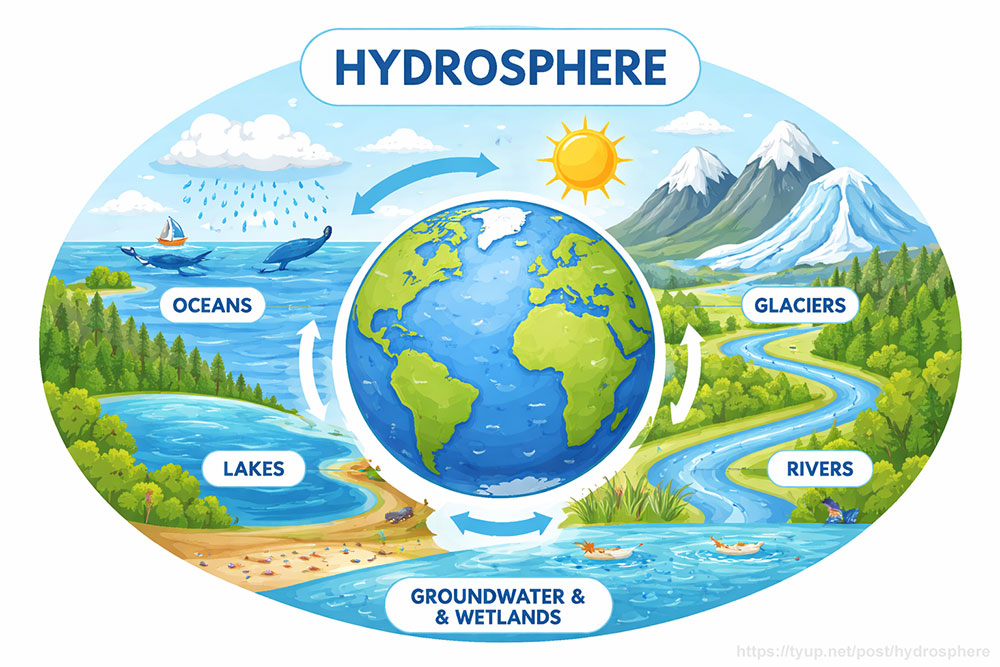
In simple terms, the hydrosphere is the water shell of the Earth. This means that water in various states surrounds and permeates all the outer layers of our planet, creating a unified environment for life.
The main layers of the hydrosphere are surface waters (the World Ocean, seas, rivers, lakes, and wetlands), groundwater or the subsurface hydrosphere (water located within the Earth's crust in the pores and fractures of rocks, including groundwater and artesian waters), glaciers or the cryosphere (glaciers, permafrost, and icebergs), and atmospheric moisture (water vapor, water droplets, and ice crystals found in the air).
Historical Overview
The term "hydrosphere" appeared much later than when humans began studying water, and its introduction is linked to the development of geology as a formal science.
Before the 19th century, scientists viewed oceans, rivers, and groundwater as separate, unrelated phenomena. It was only with the accumulation of geological knowledge that the need arose to combine them into the concept of a single global shell.
The term "hydrosphere" was introduced by the Austrian geologist Eduard Suess in 1875. He proposed this word in his work on the geology of the Alps to define the planet's water shell as a distinct category, alongside the atmosphere (air) and the lithosphere (rock shell).
According to the Merriam-Webster dictionary, the word "hydrosphere" entered the English language in 1887 as a translation of the German term hydrosphäre, introduced by Dr. Suess.
Although the name appeared in the 19th century, knowledge about the hydrosphere has been accumulating for millennia; the main milestones are described below:
- Antiquity (Aristotle, Thales): The ancient Greeks were the first to suggest that water is the fundamental basis of all existence and that it is in constant motion. In Ancient Greek: hydro (water), sphaira (sphere).
- Age of Discovery (15th–17th centuries): Navigators (Columbus, Magellan) proved the unity of the World Ocean, confirming that all seas are interconnected.
- The Challenger Expedition (1872–1876): This British ship conducted the first truly scientific global oceanographic voyage. The results of this expedition provided the foundation for understanding ocean physics and chemistry, coinciding with the emergence of Suess's term.
- 20th Century (Vladimir Vernadsky): The scientist expanded the concept of the hydrosphere by proving its inseparable link with the biosphere (living organisms) and emphasizing that water is not just a liquid, but a powerful geological force.
Structure and Composition
The structure of the hydrosphere is the total sum of the planet's water reserves, divided into oceans, land waters, and glaciers.
This means that all water on Earth is distributed across different "reservoirs," which differ from one another by their location and whether the water is salt or fresh.
To put this into perspective, the total volume of water on Earth is approximately 1.39 billion cubic kilometers, and the mass of the hydrosphere is roughly 1.46 × 10²¹ kg. This is 275 times greater than the mass of the atmosphere.
The largest volume of water is found in the oceans, with smaller amounts in glaciers, continental lakes, and groundwater. Saltwater in the oceans accounts for approximately 96.4% of the hydrosphere's volume, glacial ice 1.86%, groundwater 1.68%, and surface waters on land about 0.02%.
Surface continental waters make up only a tiny fraction of the hydrosphere. This means that all the world's rivers, lakes, and wetlands account for less than 0.02% of the planet's total water volume, as the vast majority is concentrated in salty oceans and glaciers.
Despite this, this part of the hydrosphere plays a vital role in irrigation and the biosphere. This means that rivers and lakes, despite their small volume, serve as the primary source of fresh water for agriculture and are critical for the survival of all terrestrial ecosystems.
Furthermore, this part of the hydrosphere links the atmosphere and the land. Rivers and lakes actively participate in the global cycle by evaporating moisture into the air and collecting precipitation from the Earth's surface, acting as the main link in the water exchange between the sky and the land.
The solid part of the hydrosphere (glaciers, icebergs, snow cover, and permafrost) is called the cryosphere. Scientists classify all frozen water into this separate subsystem because ice possesses unique properties and stores massive reserves of fresh water for years.
| Components of the Hydrosphere | Volume (billion km3) | % |
|---|---|---|
| World Ocean | 1370 | 93.9399 |
| Groundwater | 64 | 4.3884 |
| Glaciers | 24 | 1.6457 |
| Lakes and Reservoirs | 0.280 | 0.0192 |
| Soil Moisture | 0.085 | 0.0058 |
| Atmospheric Vapor | 0.014 | 0.0010 |
| Rivers | 0.001 | 0.0001 |
| Total Hydrosphere | 1458.38 | 100 |
Interconnection of the Hydrosphere with Other Earth Shells
The transition of water from one part of the hydrosphere to another forms the complex water cycle on Earth. This means that water is never stationary; it constantly moves between the ocean, sky, and land, changing its form from liquid to vapor or ice and back again.
Almost all layers of the hydrosphere are enveloped by the biosphere, but the highest concentration of living organisms occurs in areas warmed and illuminated by the sun. Life penetrates even the darkest depths of the ocean, but its main concentration is focused in the upper layer of water (up to 200 meters), where sunlight and heat allow plants to produce oxygen and food for all other creatures.
It is believed that life on Earth originated specifically within the hydrosphere. The primordial ocean provided the ideal chemical environment and protection from harsh cosmic radiation, allowing simple molecules to evolve into the first living cells (J.B.S. Haldane).
Human Impact
Human influence on the hydrosphere is primarily seen in the global redistribution of fresh water. This includes building dams and pumping out underground reserves to irrigate fields. This is happening so rapidly that rainfall cannot replenish the water supplies in time.
As a result, rivers dry up before reaching the sea, and entire regions face land subsidence due to the empty spaces formed underground.
Another mechanism is the chemical change in water composition. Burning fossil fuels releases carbon dioxide into the atmosphere, which then enters the ocean. This leads to ocean acidification, dissolving coral reefs and the shells of mollusks.
Plastic and fertilizers, runoff and waste discarded by humans, turn entire sections of the ocean into lifeless "dead zones" without oxygen.
In this way, humans are destroying natural water regulators, including forests and wetlands. By cutting down trees and draining swamps, the planet's ability to retain moisture and purify it naturally is reduced.
Without these natural barriers, rainwater flows immediately into the ocean, causing destructive floods and leaving the soil dry.
Clearly, human activity is making the hydrosphere less stable and more dangerous for life itself.
Monitoring of Hydrosphere Parameters
1. Pressure at Depth
Includes 1 atm of surface air pressure. Every 10m adds ~1 atm.
2. Salt Mass in Volume
Average ocean salinity is 35‰ (35 grams of salt per liter).
3. Regional Water Balance
Positive means water surplus; negative means the region is drying out.
4. Water Residence Time
The average time a water molecule stays in the reservoir (e.g., Lake Baikal data).
5. Sea Level Rise Estimate
360 Gt of melted land ice adds roughly 1 mm to global sea levels.
6. Potential Evaporation
Estimated mm of water that evaporates monthly based on temperature.